
Home / Data and methods
Data and methods
Instrument, sample, scoring, limitations and the revision of the earlier release.
Instrument
A-SCOPE MENA adapts the Social and Community Opportunities Profile (Huxley et al., 2012) to the Arab region. It covers eleven domains, eight from the source instrument and three added for the region: civic participation and voice, environmental conditions, and service provision and assistance. Each domain combines questions on access and on experience.
Sample
Fieldwork took place in 2023 and 2024 in ten Arab League states, all of which are reported: Jordan (n = 299), Morocco (254), Egypt (253), Yemen (252), Tunisia (251), Kuwait (129), Qatar (119), Lebanon (103), Iraq (101) and Saudi Arabia (100), N = 1,861. Samples are non-probability samples; scores describe respondents, not national populations.
Scoring
The raw country files were aligned to the questionnaire column by column by matching each column against the response set the questionnaire documents. 188 items are scored, 120 on the access measure and 68 on the experience measure. Each item is rescaled to 0 to 100 in the direction of access or positive experience, with the direction taken item by item from its response options. Do not know, not applicable and any value outside the documented set are missing; nothing is imputed. A respondent measure score is the mean of the items answered (at least two, or one for short batteries). A state domain score is the mean of its two measures; the index is the unweighted mean of the eleven domains; the access–experience gap is access minus experience.
In eight states some four-point items were administered on five-point scales and are rescaled on the scale used. Receipt of government or non-governmental assistance counts as access to services, following the source instrument.
Limitations
(i) Non-probability samples of 100 to 299 per state. (ii) Cross-sectional design. (iii) Item response between 52 per cent (Morocco) and 96 per cent (Tunisia); non-response is not random. (iv) Cultural differences in the expression of satisfaction affect the experience measure. (v) Iraq and Yemen were affected by conflict during fieldwork. (vi) In four files, respondents share identical answers on all 188 scored items with at least one other respondent while differing on unscored fields. The number of distinct answer patterns is 7 of 251 in Tunisia, 22 of 101 in Iraq, 41 of 100 in Saudi Arabia and 66 of 119 in Qatar. Removing the duplicated patterns changes the index by 0.2 points or less for Tunisia, Iraq and Saudi Arabia and lowers Qatar from 53.4 to 52.0; the position of Tunisia cannot be tested in this way. Scores are reported as the data give them. (vii) Twelve Arab League states are not covered. (viii) Some access scores (digital use and safety in Saudi Arabia and Qatar) are out of line with other evidence and are read at item level before policy use. (ix) The data do not measure administrative capacity or service delivery; all administrative explanations are inferences.
Representativeness and how to read the results
The samples are not representative. The A-SCOPE MENA samples were not drawn by probability methods from a defined sampling frame. The probability that any resident was selected is unknown, no design or post-stratification weights are applied, and the composition of each sample was not controlled to match the population by age, sex, region, urban or rural residence, education, employment or nationality. Samples range from 100 to 299 respondents per state. The scores therefore describe the people who were surveyed. They are not estimates for the national populations of the ten states, and they cannot be generalised to those populations.
Consequences for the reading of results. (i) Because selection probabilities are unknown, the usual measures of sampling error, standard errors, confidence intervals and significance tests, cannot be computed in a meaningful way, and none is reported. (ii) Differences between states may reflect differences in who was surveyed as much as differences in conditions or in public administration. A state whose sample includes more educated, urban or employed respondents will tend to score higher on several domains for that reason alone. (iii) Small differences carry no interpretive weight: Jordan and Morocco share a score of 54.4, and Qatar (53.4) and Egypt (53.3) differ by a tenth of a point. Rankings are indicative orderings of the samples, not league tables of states. (iv) Comparisons within a state, between domains and between the access and experience tracks, are less exposed to sample composition than comparisons between states, because both measures are answered by the same respondents; they remain affected by it.
How the results should be used. The index, the typology and the domain analyses are exploratory and descriptive. They identify patterns, above all the divergence between access and experience, that merit explanation and testing. They should be read as hypotheses about where conversion from provision to experience may be failing, not as measurements of national conditions or of government performance. They should not be used to set policy targets, to allocate resources, to evaluate or rank governments, or as a substitute for official statistics. Any citation of a score should carry this qualification.
The next wave. Future work of the observatory will focus on representative surveys. The next wave is designed around probability samples drawn from defined national frames, stratified by region and by urban and rural residence and, where relevant, by nationality; sample sizes sufficient to support estimates for the main population groups; survey weights, published design effects and confidence intervals for every score; standardised fieldwork protocols with quality controls, including checks for duplicated records; and extended coverage of Arab League states in repeated waves. Until such data are available, the present results are a first description of access and experience in ten samples, and a basis for the questions a representative survey should answer.
Citation
Ben Brik, A. (2026). From Provision to Experience: A Public Administration Analysis of Access to Services, Resources and Opportunities in the Arab States. Arab Access and Experience Index (AAEI) 2026. مرصد الإدارة, Administration Observatory in the Arab Region.
Data: A-SCOPE MENA: Arab Access and Experience Dataset, 2026. Ben Brik, A. and Taylor Brown, C.
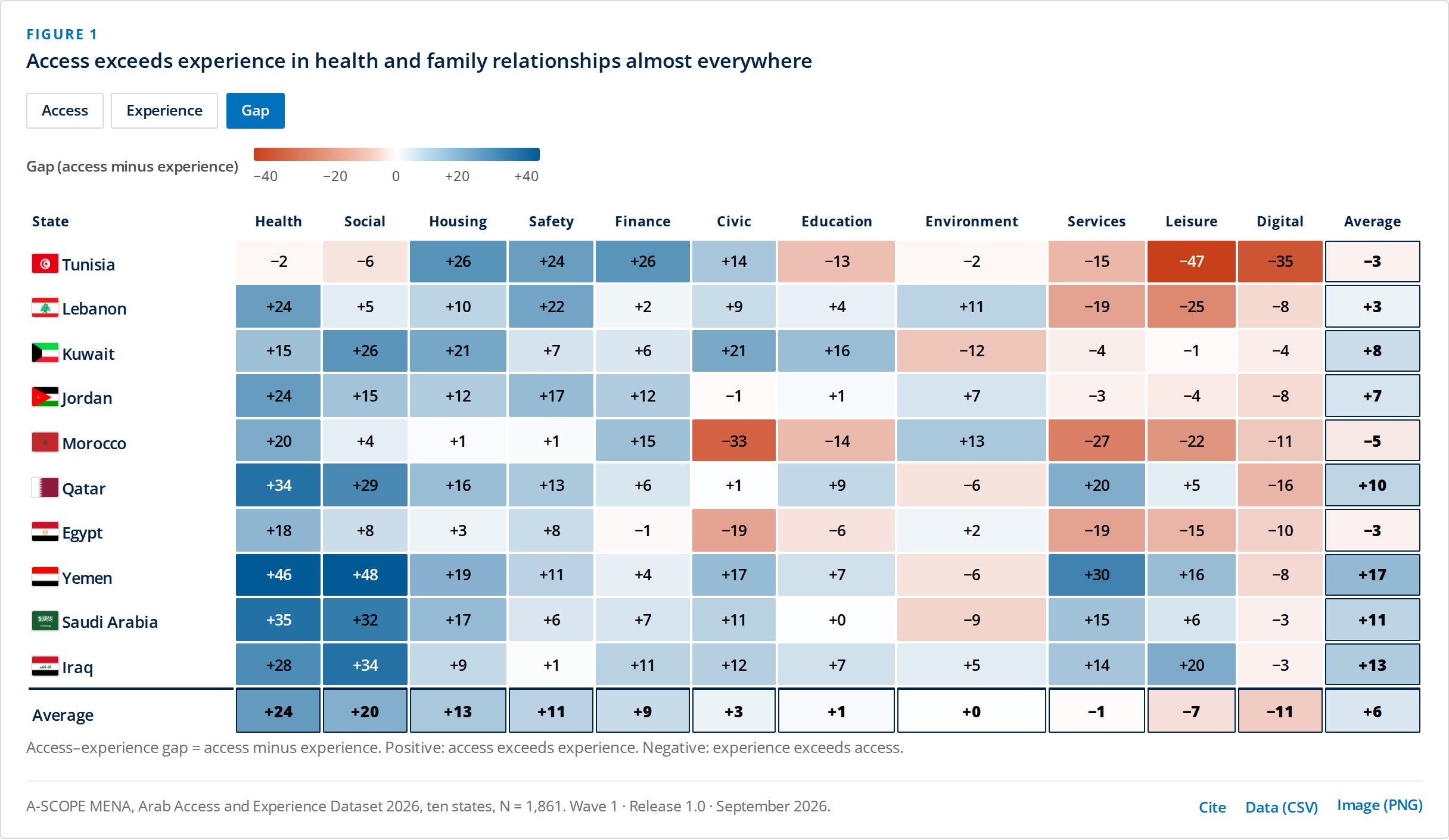
| State | Health | Social | Housing | Safety | Finance | Civic | Education | Environment | Services | Leisure | Digital | Average |
|---|---|---|---|---|---|---|---|---|---|---|---|---|
| Tunisia | −2 | −6 | +26 | +24 | +26 | +14 | −13 | −2 | −15 | −47 | −36 | −3 |
| Lebanon | +23 | +5 | +10 | +22 | +2 | +8 | +4 | +11 | −19 | −25 | −8 | +3 |
| Kuwait | +15 | +26 | +21 | +7 | +6 | +21 | +16 | −12 | −4 | −1 | −4 | +8 |
| Jordan | +24 | +14 | +12 | +16 | +12 | −1 | +1 | +7 | −3 | −4 | −8 | +7 |
| Morocco | +20 | +4 | +1 | +1 | +15 | −33 | −14 | +13 | −27 | −22 | −12 | −5 |
| Qatar | +34 | +28 | +16 | +13 | +6 | +0 | +9 | −6 | +20 | +5 | −16 | +10 |
| Egypt | +18 | +8 | +3 | +8 | −1 | −19 | −6 | +2 | −19 | −16 | −10 | −3 |
| Yemen | +46 | +48 | +19 | +11 | +4 | +16 | +7 | −6 | +30 | +16 | −8 | +17 |
| Saudi Arabia | +34 | +32 | +16 | +6 | +7 | +11 | +0 | −9 | +15 | +6 | −3 | +10 |
| Iraq | +28 | +34 | +9 | +1 | +11 | +12 | +7 | +5 | +14 | +20 | −3 | +12 |
| Average | +24 | +20 | +13 | +11 | +9 | +3 | +1 | +0 | −1 | −7 | −11 | +6 |
Access–experience gap = access minus experience. Positive: access exceeds experience. Negative: experience exceeds access.
References
- Ben Brik, A. and Brown, C. T. (2025). Critical review of conceptualisation and measurement of social inclusion: directions for conceptual clarity. Social Policy and Society, 1–18. https://doi.org/10.1017/S1474746425000302
- Brik, A. B. and Brown, C. T. (2024). Global trends in social inclusion and social inclusion policy: a systematic review and research agenda. Social Policy and Society, 1–24. https://doi.org/10.1017/S147474642400054X
- Brown, C. T. and Brik, A. B. (2024). Welfare regime typologies: the six worlds of social inclusion. International Journal of Community and Social Development. https://doi.org/10.1017/ics.2024.14
- Ben Brik, A. and Taylor Brown, C. (2025). A-SCOPE MENA: adapting the Social and Community Opportunities Profile for the Arab world. Methodological paper, available on request.
- Huxley, P. et al. (2012). Development of a social inclusion index to capture subjective and objective life domains (Phase II): psychometric development study. Health Technology Assessment, 16(1), 1–248. https://doi.org/10.3310/hta16010