Home / Key findings
Key findings
The main results of the first wave, in plain terms, with the qualification that they describe the people surveyed.
Samples are not representative: scores describe respondents, not national populations. Comparisons are indicative and small differences carry no weight. See Data and methods.
Access and experience diverge.
Across the ten states the access and experience indices correlate at 0.45, a relationship carried by Tunisia, which records the highest value on both. Among the other nine states the correlation is 0.00.
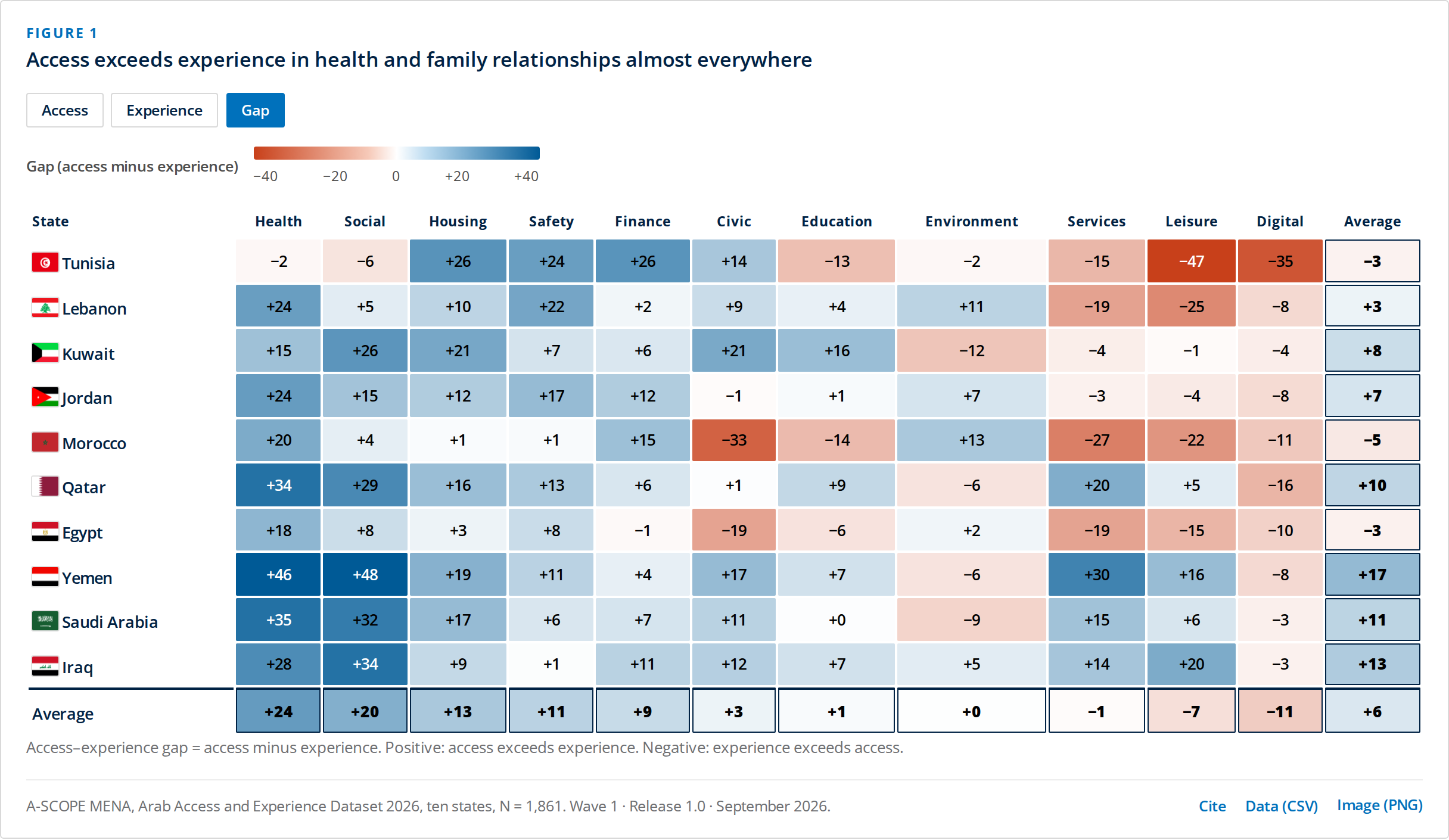
Access usually runs ahead of experience.
In 74 of 110 state-by-domain cells access exceeds experience. The gap is largest in health and care (24.2 points on average) and in family and social relationships (19.4).
In three domains the measures move in opposite directions.
Leisure (r = −0.82), civic participation (−0.34) and service provision (−0.33): the states with the most recorded participation or assistance tend to be those whose residents value it least.
The weakest domains are service provision, civic participation and leisure.
Regional means of 45.9, 47.6 and 47.8. Service provision and education move against the index (r = −0.47 and −0.48): Tunisia, first overall, is last on both.
Five administrative challenges.
Provision–experience mismatch (Qatar, Saudi Arabia, Kuwait); material-access deficit (Morocco, Egypt); administrative interface deficit (Tunisia, Lebanon); capacity under crisis (Yemen, Iraq); intermediate alignment (Jordan).
The explanation is administrative, the evidence is descriptive.
The pattern is consistent with administrative capacity acting as a link between provision and experience between provision and experience. The data are cross-sectional and do not measure administrative capacity; the report states the proposition and marks every mechanism as an inference.
| State | Health | Social | Housing | Safety | Finance | Civic | Education | Environment | Services | Leisure | Digital | Average |
|---|---|---|---|---|---|---|---|---|---|---|---|---|
| Tunisia | −2 | −6 | +26 | +24 | +26 | +14 | −13 | −2 | −15 | −47 | −36 | −3 |
| Lebanon | +23 | +5 | +10 | +22 | +2 | +8 | +4 | +11 | −19 | −25 | −8 | +3 |
| Kuwait | +15 | +26 | +21 | +7 | +6 | +21 | +16 | −12 | −4 | −1 | −4 | +8 |
| Jordan | +24 | +14 | +12 | +16 | +12 | −1 | +1 | +7 | −3 | −4 | −8 | +7 |
| Morocco | +20 | +4 | +1 | +1 | +15 | −33 | −14 | +13 | −27 | −22 | −12 | −5 |
| Qatar | +34 | +28 | +16 | +13 | +6 | +0 | +9 | −6 | +20 | +5 | −16 | +10 |
| Egypt | +18 | +8 | +3 | +8 | −1 | −19 | −6 | +2 | −19 | −16 | −10 | −3 |
| Yemen | +46 | +48 | +19 | +11 | +4 | +16 | +7 | −6 | +30 | +16 | −8 | +17 |
| Saudi Arabia | +34 | +32 | +16 | +6 | +7 | +11 | +0 | −9 | +15 | +6 | −3 | +10 |
| Iraq | +28 | +34 | +9 | +1 | +11 | +12 | +7 | +5 | +14 | +20 | −3 | +12 |
| Average | +24 | +20 | +13 | +11 | +9 | +3 | +1 | +0 | −1 | −7 | −11 | +6 |
Access–experience gap = access minus experience. Positive: access exceeds experience. Negative: experience exceeds access.