
Home / Five administrative challenges
Five administrative challenges
The states are grouped by the shape of their access and experience profiles, not by regime type or region. Each type names a different point in the chain where provision appears not to become experience.
Provision–experience mismatchMaterial-access deficitAdministrative interface deficitCapacity under crisisIntermediate alignment
Dashed line: access equals experienceDotted lines: regional averages
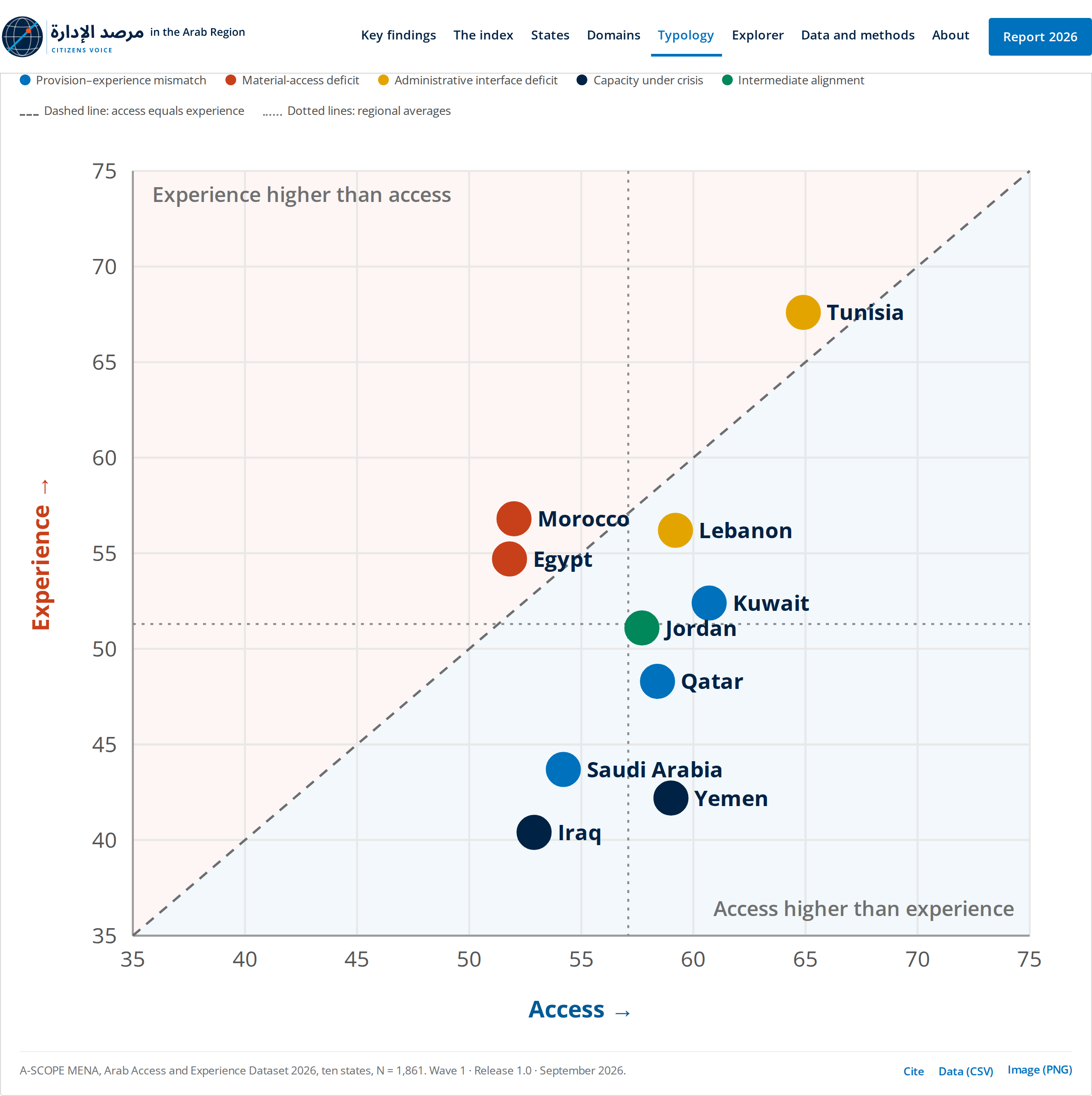
Access above the regional mean in Kuwait and Qatar and below it in Saudi Arabia; experience 8 to 11 points below access on the index; gaps above 25 points on family relationships in all three and above 30 on health in Qatar and Saudi Arabia.
Administrative problem. Turning provision into experience: quality, responsiveness and the experience of users.
Why does provision that residents report as available not become access they value?
Experience above access; the two lowest access indices in the sample; large negative gaps on civic participation and services in both, and on education in Morocco.
Administrative problem. Insufficient material provision that satisfaction data would understate.
Where would expanding provision change what residents can actually do?
Strong material and social conditions and the lowest scores in the sample on the domains of direct public provision: Tunisia is last on service provision and education, Lebanon last on civic participation and second last on services. Morocco shares the service weakness.
Administrative problem. Procedures, eligibility, information, complaint handling and channels of voice.
How can the interface between administration and resident catch up with conditions that are otherwise strong?
The lowest experience indices and the largest gaps in the sample; the lowest digital access; low safety. In Yemen, high recorded contact, self-rated health and receipt of assistance sit beside low experience.
Administrative problem. Sustaining delivery and building durable state capacity amid instability.
How can delivery be sustained, and experience raised, while provision passes from humanitarian to state actors?
Access above the regional mean and experience at it (51.1 against 51.3), a moderate gap (6.6), and no domain more than four points below the regional mean.
Administrative problem. Preserving alignment while addressing the weakest domains.
Which domains can be raised without widening the gap?
| Type | States | Pattern | Administrative problem | Question |
|---|---|---|---|---|
| Provision–experience mismatch | Qatar, Saudi Arabia, Kuwait | Access above the regional mean in Kuwait and Qatar and below it in Saudi Arabia; experience 8 to 11 points below access on the index; gaps above 25 points on family relationships in all three and above 30 on health in Qatar and Saudi Arabia. | Turning provision into experience: quality, responsiveness and the experience of users. | Why does provision that residents report as available not become access they value? |
| Material-access deficit | Morocco, Egypt | Experience above access; the two lowest access indices in the sample; large negative gaps on civic participation and services in both, and on education in Morocco. | Insufficient material provision that satisfaction data would understate. | Where would expanding provision change what residents can actually do? |
| Administrative interface deficit | Tunisia, Lebanon | Strong material and social conditions and the lowest scores in the sample on the domains of direct public provision: Tunisia is last on service provision and education, Lebanon last on civic participation and second last on services. Morocco shares the service weakness. | Procedures, eligibility, information, complaint handling and channels of voice. | How can the interface between administration and resident catch up with conditions that are otherwise strong? |
| Capacity under crisis | Yemen, Iraq | The lowest experience indices and the largest gaps in the sample; the lowest digital access; low safety. In Yemen, high recorded contact, self-rated health and receipt of assistance sit beside low experience. | Sustaining delivery and building durable state capacity amid instability. | How can delivery be sustained, and experience raised, while provision passes from humanitarian to state actors? |
| Intermediate alignment | Jordan | Access above the regional mean and experience at it (51.1 against 51.3), a moderate gap (6.6), and no domain more than four points below the regional mean. | Preserving alignment while addressing the weakest domains. | Which domains can be raised without widening the gap? |