
مرصد الإدارة
in the Arab Region
Citizens VoiceAccess is not experience.
The Observatory observes how residents of Arab states reach public services, resources and opportunities, and how they experience what they reach. Its flagship measure, the Arab Access and Experience Index, records both for eleven domains of everyday life, so that the distance between provision and experience becomes visible and comparable.
Samples are not representative: scores describe respondents, not national populations. Comparisons are indicative and small differences carry no weight. See Data and methods.
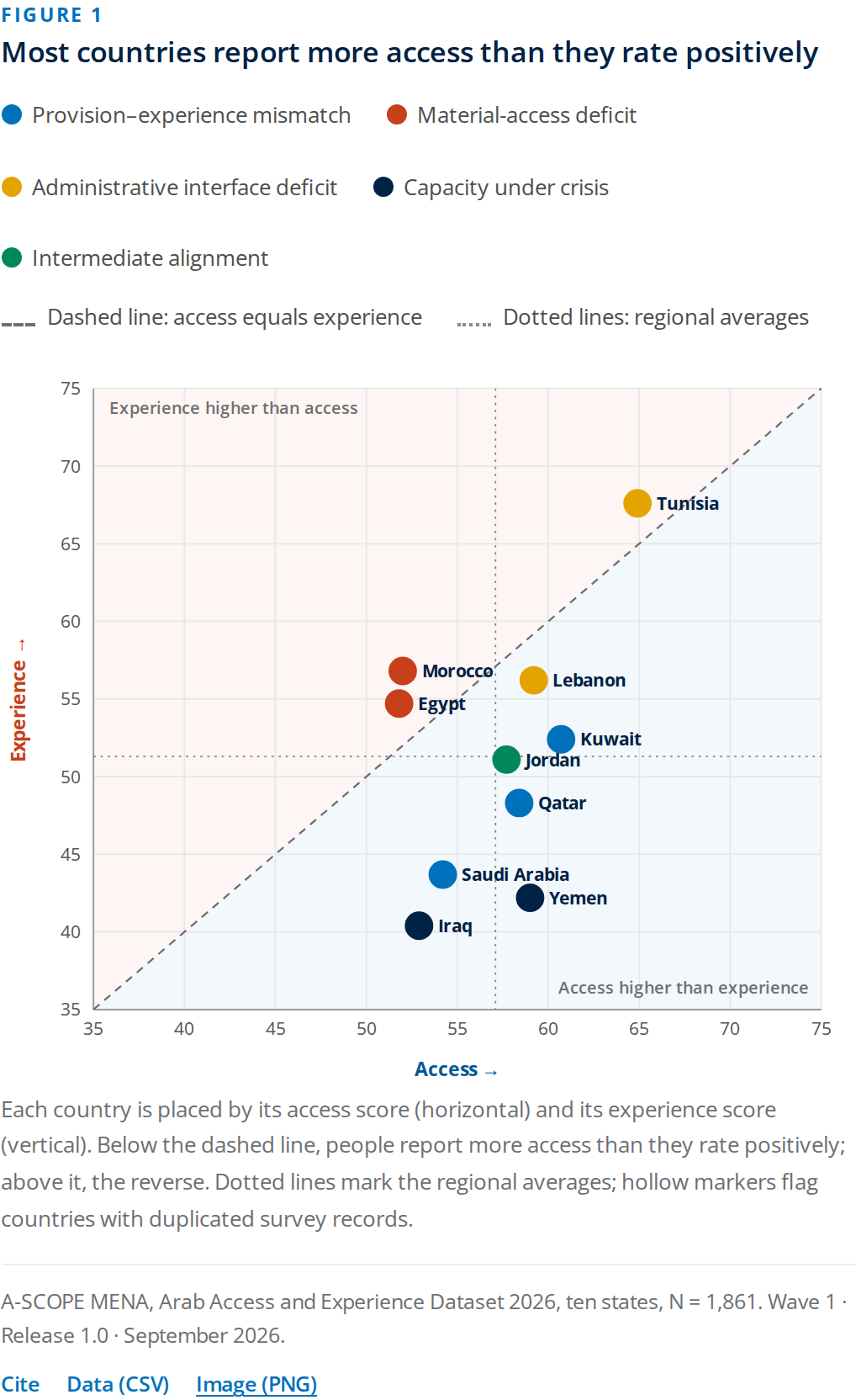
Provision–experience mismatchMaterial-access deficitAdministrative interface deficitCapacity under crisisIntermediate alignment
Dashed line: access equals experienceDotted lines: regional averages
Each country is placed by its access score (horizontal) and its experience score (vertical). Below the dashed line, people report more access than they rate positively; above it, the reverse. Dotted lines mark the regional averages; hollow markers flag countries with duplicated survey records.
From provision to experience
Public administration is concerned with turning provision into access that people can use and value. The survey observes the last stages of that chain. What happens between them, in procedures, eligibility, affordability, responsiveness and quality, is where the administrative explanation lies, and it is inferred rather than measured.
Provision
Services, infrastructure, entitlements and regulation put in place by public institutions.
Access
What residents report being able to obtain, use or take part in.
Use and benefit
Whether access becomes use: affordability, eligibility, procedures, information, distance.
Experience
Whether residents find what they reach adequate, responsive and worth having.
Where access and experience part company
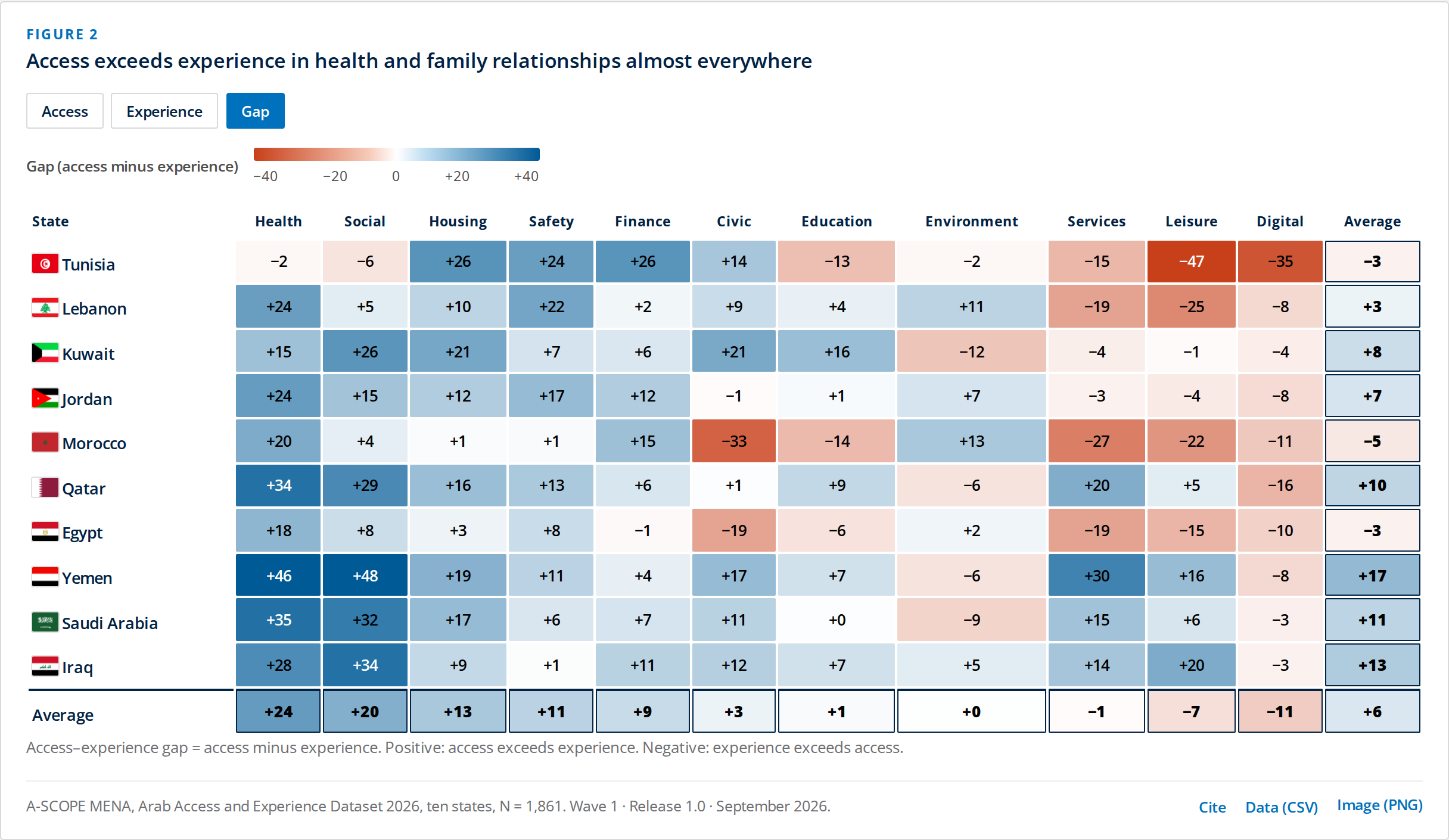
Ten states by eleven domains. Switch between access, experience and the access–experience gap. Health and family relationships show access far above experience in nine of ten states; digital access shows the reverse in all ten; leisure, civic participation and services divide the states.
| State | Health | Social | Housing | Safety | Finance | Civic | Education | Environment | Services | Leisure | Digital | Average |
|---|---|---|---|---|---|---|---|---|---|---|---|---|
| Tunisia | −2 | −6 | +26 | +24 | +26 | +14 | −13 | −2 | −15 | −47 | −36 | −3 |
| Lebanon | +23 | +5 | +10 | +22 | +2 | +8 | +4 | +11 | −19 | −25 | −8 | +3 |
| Kuwait | +15 | +26 | +21 | +7 | +6 | +21 | +16 | −12 | −4 | −1 | −4 | +8 |
| Jordan | +24 | +14 | +12 | +16 | +12 | −1 | +1 | +7 | −3 | −4 | −8 | +7 |
| Morocco | +20 | +4 | +1 | +1 | +15 | −33 | −14 | +13 | −27 | −22 | −12 | −5 |
| Qatar | +34 | +28 | +16 | +13 | +6 | +0 | +9 | −6 | +20 | +5 | −16 | +10 |
| Egypt | +18 | +8 | +3 | +8 | −1 | −19 | −6 | +2 | −19 | −16 | −10 | −3 |
| Yemen | +46 | +48 | +19 | +11 | +4 | +16 | +7 | −6 | +30 | +16 | −8 | +17 |
| Saudi Arabia | +34 | +32 | +16 | +6 | +7 | +11 | +0 | −9 | +15 | +6 | −3 | +10 |
| Iraq | +28 | +34 | +9 | +1 | +11 | +12 | +7 | +5 | +14 | +20 | −3 | +12 |
| Average | +24 | +20 | +13 | +11 | +9 | +3 | +1 | +0 | −1 | −7 | −11 | +6 |
Access–experience gap = access minus experience. Positive: access exceeds experience. Negative: experience exceeds access.
In their own words
What respondents said they would change. Open-ended answers as transcribed in English by the survey team, lightly edited for punctuation; attributed by country only.
“The presence of doctors in all areas”
Egypt · Health
“Get the opinion of citizens on this matter”
Egypt · Civic
“There is no money to cover the costs”
Qatar · Education
“I want to find a job close to my residence”
Yemen · Finance
Access to what?
The eleven domains differ in kind. Some are public services; others are material conditions, basic conditions, or social and civic opportunities that administrations shape only in part. The observatory groups them accordingly and marks how directly public administration bears on each.
Public services
Services supplied or financed by public agencies.
Education and trainingDirectHealth and careDirectService provision and assistanceDirectMaterial conditions
Conditions of shelter, livelihood and surroundings.
HousingSharedWork, income and financeSharedEnvironmental conditionsSharedBasic conditions
Conditions that make other access possible.
Digital access and useSharedSafety and policingDirectSocial opportunities
Relationships and shared activity.
Leisure and community participationLimitedFamily and social relationshipsLimitedFive administrative challenges
The states are grouped by the shape of their access and experience profiles, not by regime type or region. Each type names a different point in the chain where provision appears not to become experience.
Access above the regional mean in Kuwait and Qatar and below it in Saudi Arabia; experience 8 to 11 points below access on the index; gaps above 25 points on family relationships in all three and above 30 on health in Qatar and Saudi Arabia.
Administrative problem. Turning provision into experience: quality, responsiveness and the experience of users.
Why does provision that residents report as available not become access they value?
Experience above access; the two lowest access indices in the sample; large negative gaps on civic participation and services in both, and on education in Morocco.
Administrative problem. Insufficient material provision that satisfaction data would understate.
Where would expanding provision change what residents can actually do?
Strong material and social conditions and the lowest scores in the sample on the domains of direct public provision: Tunisia is last on service provision and education, Lebanon last on civic participation and second last on services. Morocco shares the service weakness.
Administrative problem. Procedures, eligibility, information, complaint handling and channels of voice.
How can the interface between administration and resident catch up with conditions that are otherwise strong?
The lowest experience indices and the largest gaps in the sample; the lowest digital access; low safety. In Yemen, high recorded contact, self-rated health and receipt of assistance sit beside low experience.
Administrative problem. Sustaining delivery and building durable state capacity amid instability.
How can delivery be sustained, and experience raised, while provision passes from humanitarian to state actors?
Access above the regional mean and experience at it (51.1 against 51.3), a moderate gap (6.6), and no domain more than four points below the regional mean.
Administrative problem. Preserving alignment while addressing the weakest domains.
Which domains can be raised without widening the gap?
From Provision to Experience
A Public Administration Analysis of Access to Services, Resources and Opportunities in the Arab States
The 2026 report of the Observatory: a public administration analysis of access to services, resources and opportunities in ten Arab states. Thirteen chapters, 11 figures and 9 tables, in English, French and Arabic.
What the observatory publishes
The index
Access, experience and the access–experience gap for ten states and eleven domains, with absolute scores that do not depend on the sample of states.
State profiles
Each state by domain, with its administrative type and the domains where the gap is widest.
Domain analyses
What the survey asks, what it finds, what the gap may indicate and what it cannot show.
Open methods
The item specification, scoring code and data-quality diagnostics behind every figure.