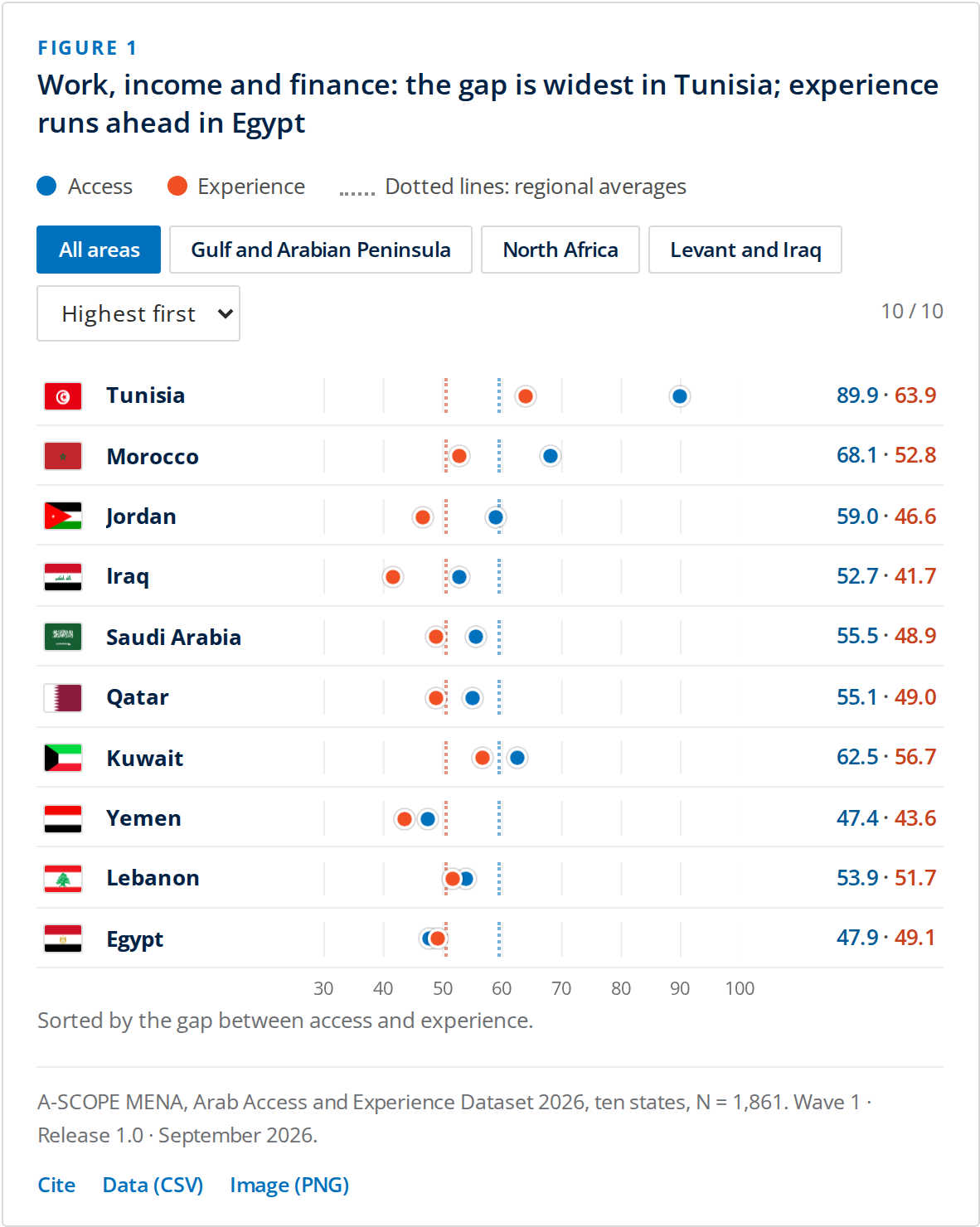
Access and experience by state
Each line connects the access score of a state (left) with its experience score (right). A downward slope indicates that access exceeds experience; an upward slope indicates the reverse. The gradient is proportional to the gap.
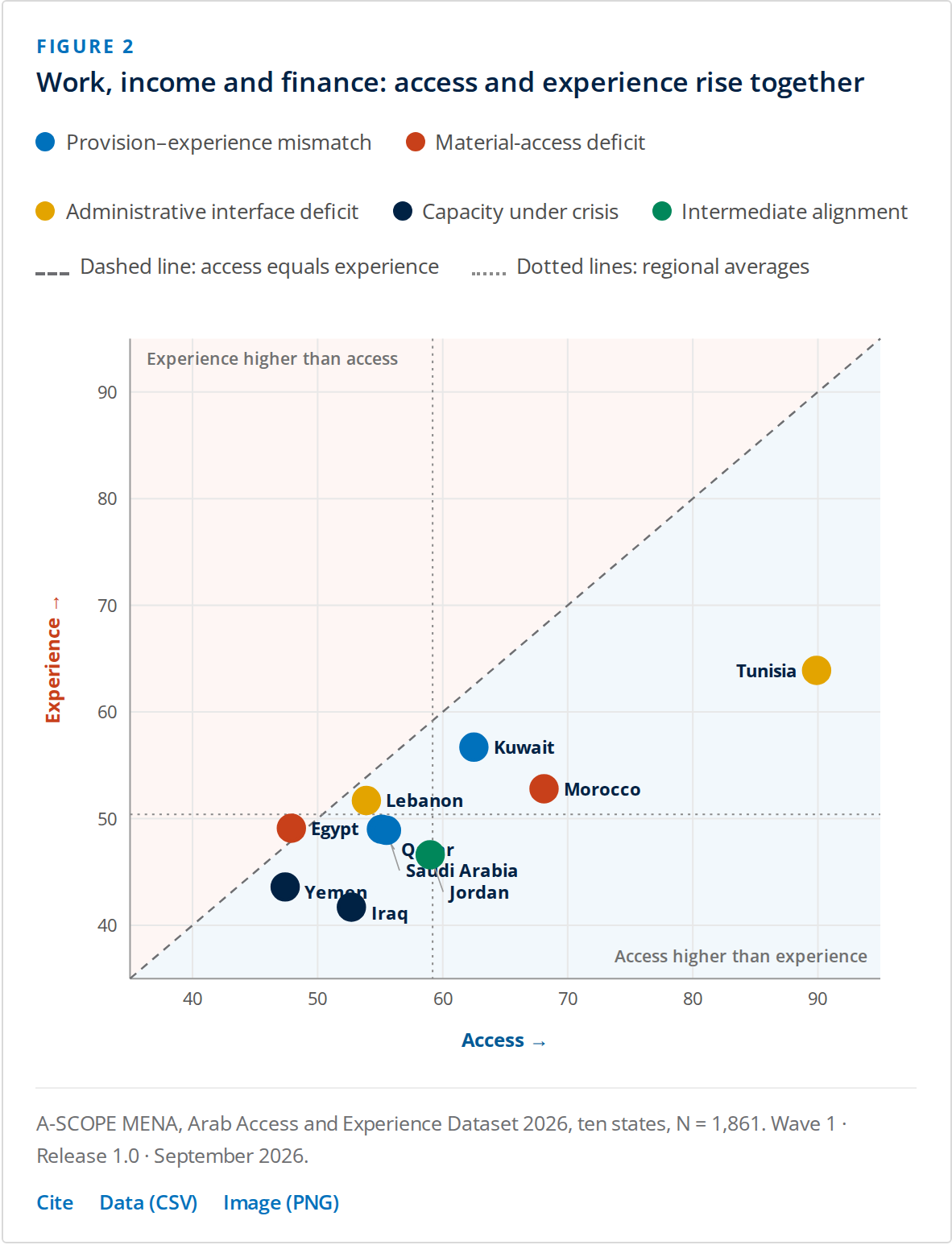
Bivariate distribution of access and experience
States are classified into terciles of access and of experience in this domain, relative to the other nine states, and shaded accordingly.
Source: A-SCOPE MENA, Arab Access and Experience Dataset 2026 · non-probability samples; scores describe respondents.
The ten states in this domain
Ranking
Employment status; arrears on rent or mortgage; ability to borrow a small sum; a bank near the home and its use for saving or credit.
Feelings about the current job or about not working, how well the household is managing, ease of covering housing costs, views on opportunities to find work and to increase income, and feelings about personal and household finances.
Findings
Access ranges from 47.4 (Yemen) to 89.9 (Tunisia); experience from 41.7 (Iraq) to 63.9 (Tunisia). Access exceeds experience in nine states, most in Tunisia (26.0), Morocco (15.3) and Jordan (12.4); Egypt is the exception (47.9 and 49.1).
Citizens voice
“I want to find a job close to my residence”
Yemen
“Providing more opportunities for young people”
Egypt
What respondents said they would change. Open-ended answers as transcribed in English by the survey team, lightly edited for punctuation; attributed by country only.
AccessExperienceDotted lines: regional averages
Sorted by the gap between access and experience.
Gulf and Arabian PeninsulaLevant and IraqNorth Africa
Dashed line: access equals experienceDotted lines: regional averages