Administration Observatory in the Arab Region · Citizens VoicePressSearch
مرصد الإدارةin the Arab RegionCitizens Voice

Home / Domains / Basic conditions

Safety and policing

Role of government: Direct   Shaped directly by public agencies.

Access and experience by state

Each line connects the access score of a state (left) with its experience score (right). A downward slope indicates that access exceeds experience; an upward slope indicates the reverse. The gradient is proportional to the gap.

Bivariate distribution of access and experience

States are classified into terciles of access and of experience in this domain, relative to the other nine states, and shaded accordingly.

Source: A-SCOPE MENA, Arab Access and Experience Dataset 2026 · non-probability samples; scores describe respondents.

The ten states in this domain

Ranking

AccessExperience
66.6Access · regional mean
55.8Experience · regional mean
+10.8Access–experience gap
0.89How closely access and experience move together across countries (correlation)
What the survey asks: access

Walking alone in the area after dark; victimisation by crime or assault in the past year.

What the survey asks: experience

Feeling safe after dark and in the area; satisfaction with public and personal safety; the expected likelihood of police protection, of abuse of power and of prosecution of officers.

Findings

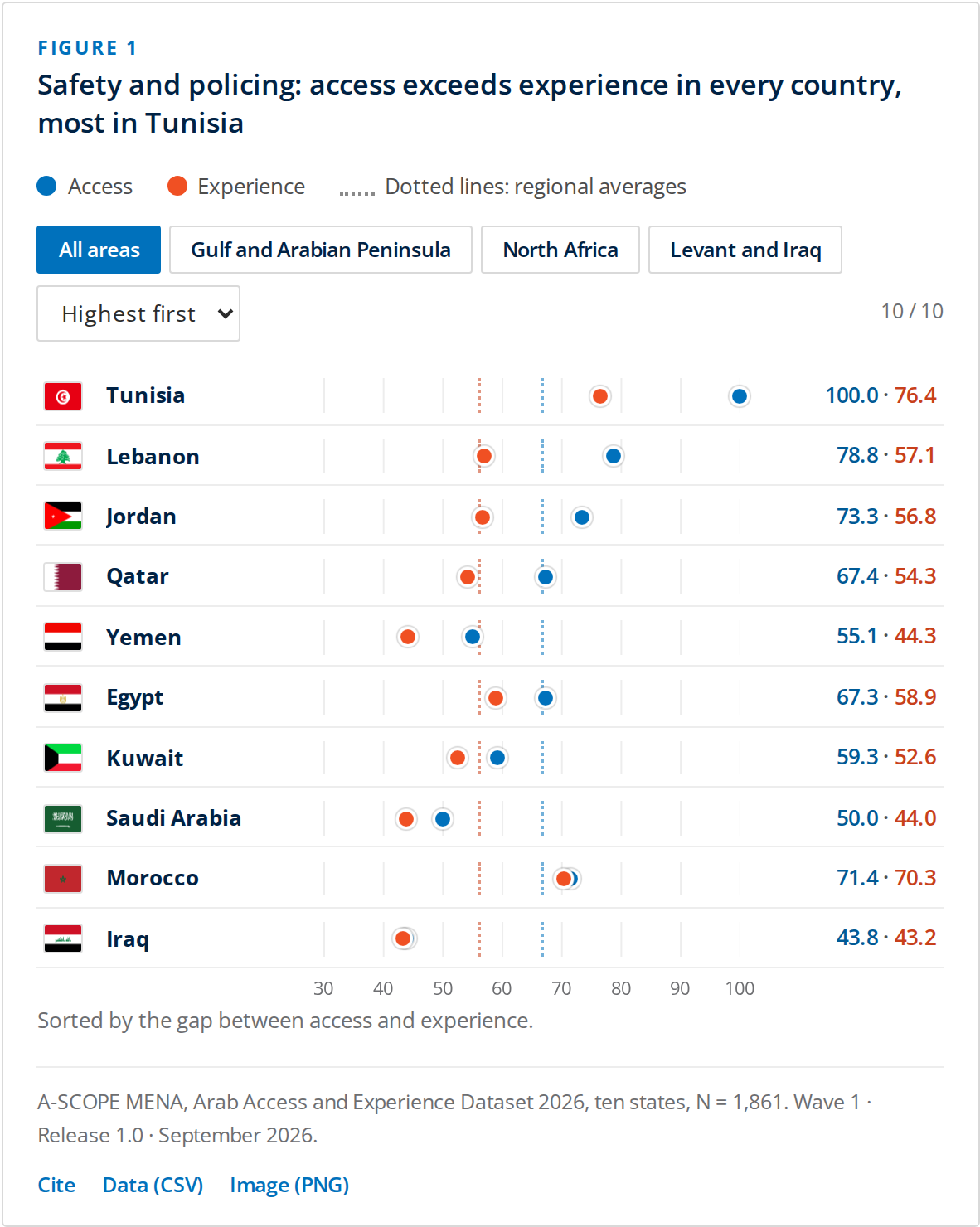
Access exceeds experience in all ten states, from 0.6 points in Iraq to 23.6 in Tunisia and 21.7 in Lebanon. Every Tunisian respondent reports walking alone after dark and no victimisation (access 100.0). Morocco follows (71.4 and 70.3); Iraq is lowest on both measures (43.8 and 43.2).

Safety is one of the domains that carry the ranking of states (r = 0.92).

What the gap may indicate (inference, not measured)Several experience items concern the police and the prosecution of officers. A gap between low reported victimisation and low experienced safety is consistent with limited confidence in policing institutions; the survey records the expectation, not the conduct of the police.
Administrative implicationInterior ministries and municipal authorities can treat confidence in policing and visible presence in public space as outcomes in their own right.
Figure 1Safety and policing: access exceeds experience in every country, most in Tunisia

AccessExperienceDotted lines: regional averages

Sorted by the gap between access and experience.
A-SCOPE MENA, Arab Access and Experience Dataset 2026, ten states, N = 1,861. Wave 1 · Release 1.0 · September 2026.Image (PNG)
Figure 2Safety and policing: access and experience rise together

Gulf and Arabian PeninsulaLevant and IraqNorth Africa

Dashed line: access equals experienceDotted lines: regional averages
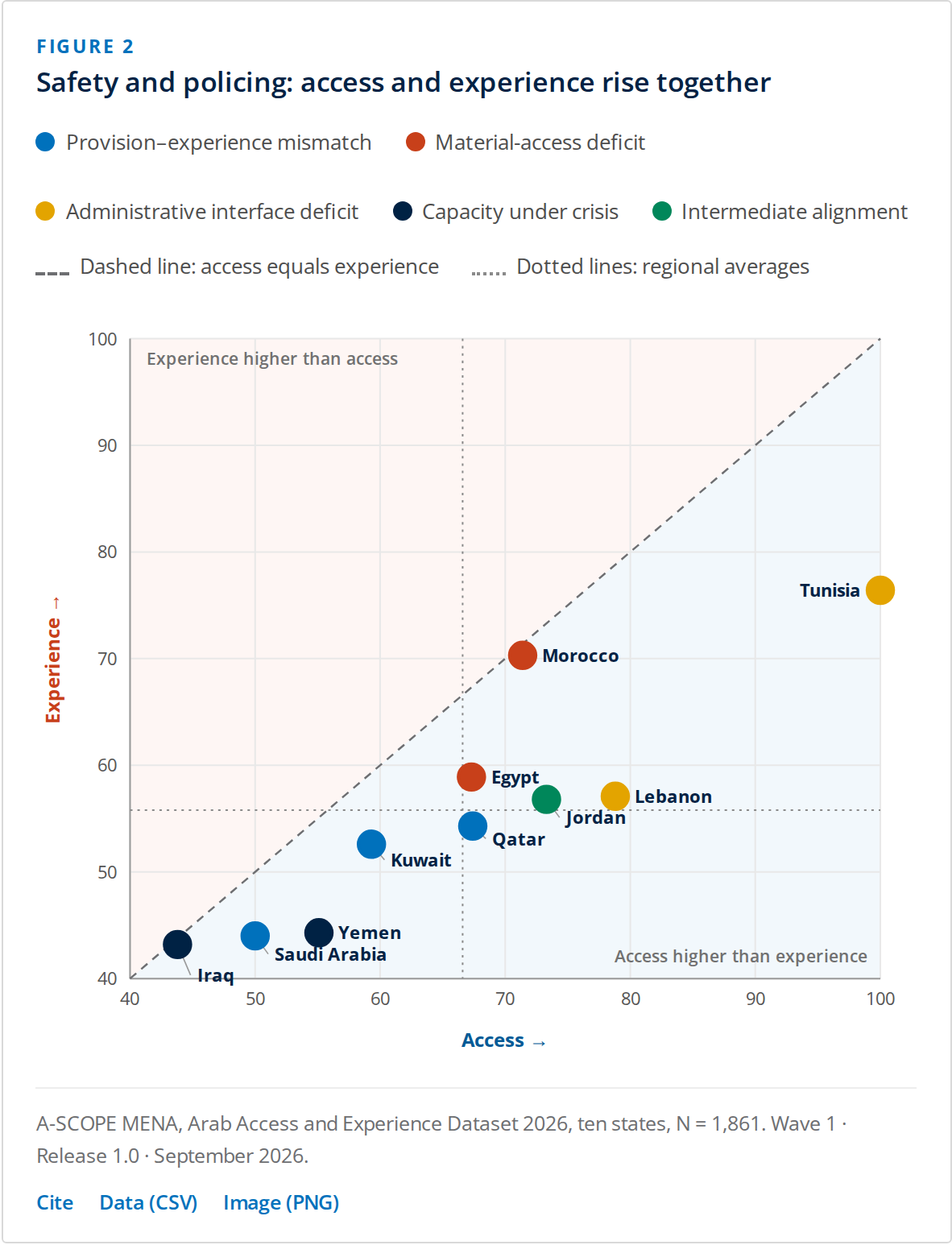
404050506060707080809090100100Experience higher than accessAccess higher than experienceAccess →Experience →TunisiaMoroccoEgyptLebanonJordanQatarKuwaitYemenSaudi ArabiaIraq
A-SCOPE MENA, Arab Access and Experience Dataset 2026, ten states, N = 1,861. Wave 1 · Release 1.0 · September 2026.Image (PNG)