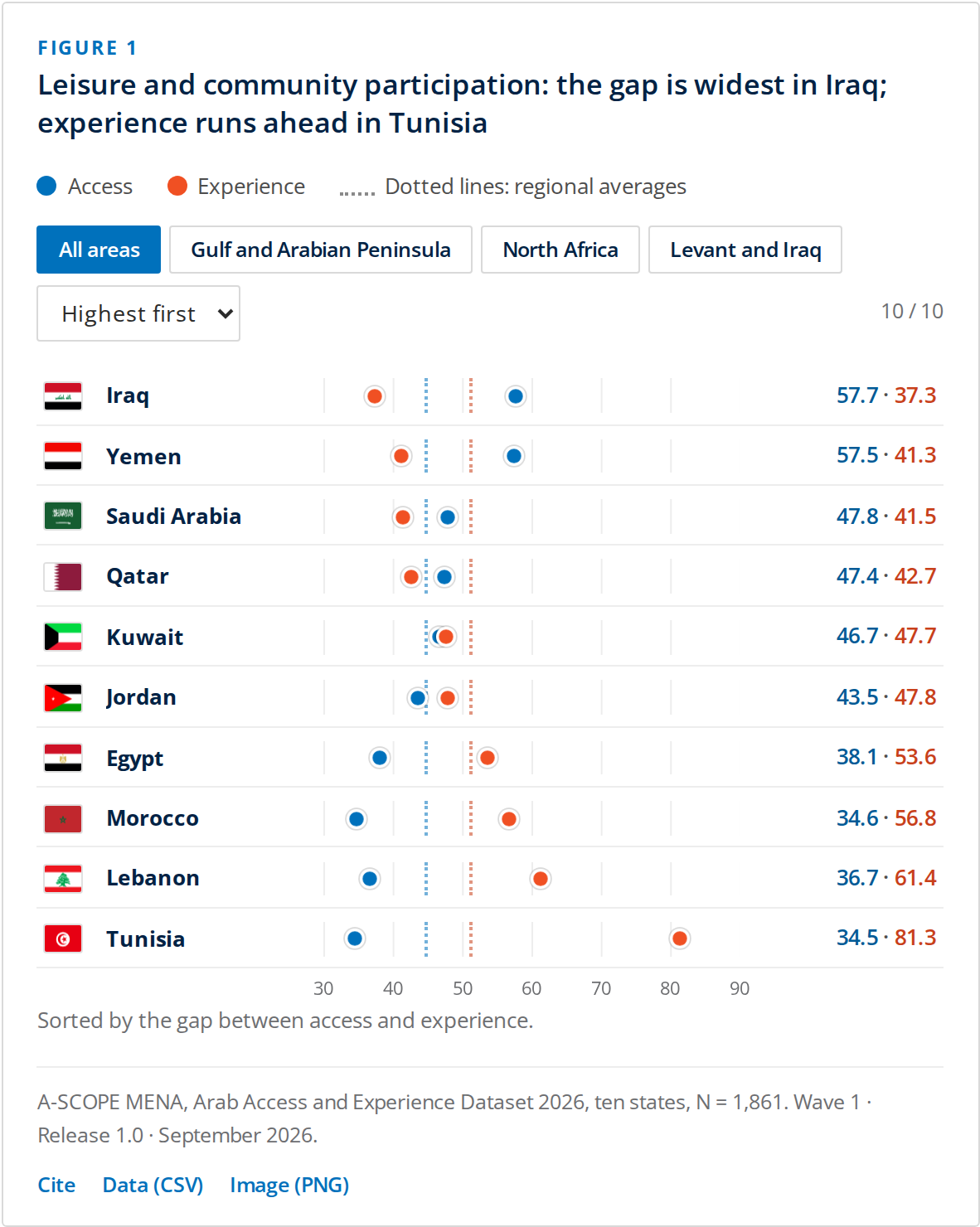
Access and experience by state
Each line connects the access score of a state (left) with its experience score (right). A downward slope indicates that access exceeds experience; an upward slope indicates the reverse. The gradient is proportional to the gap.
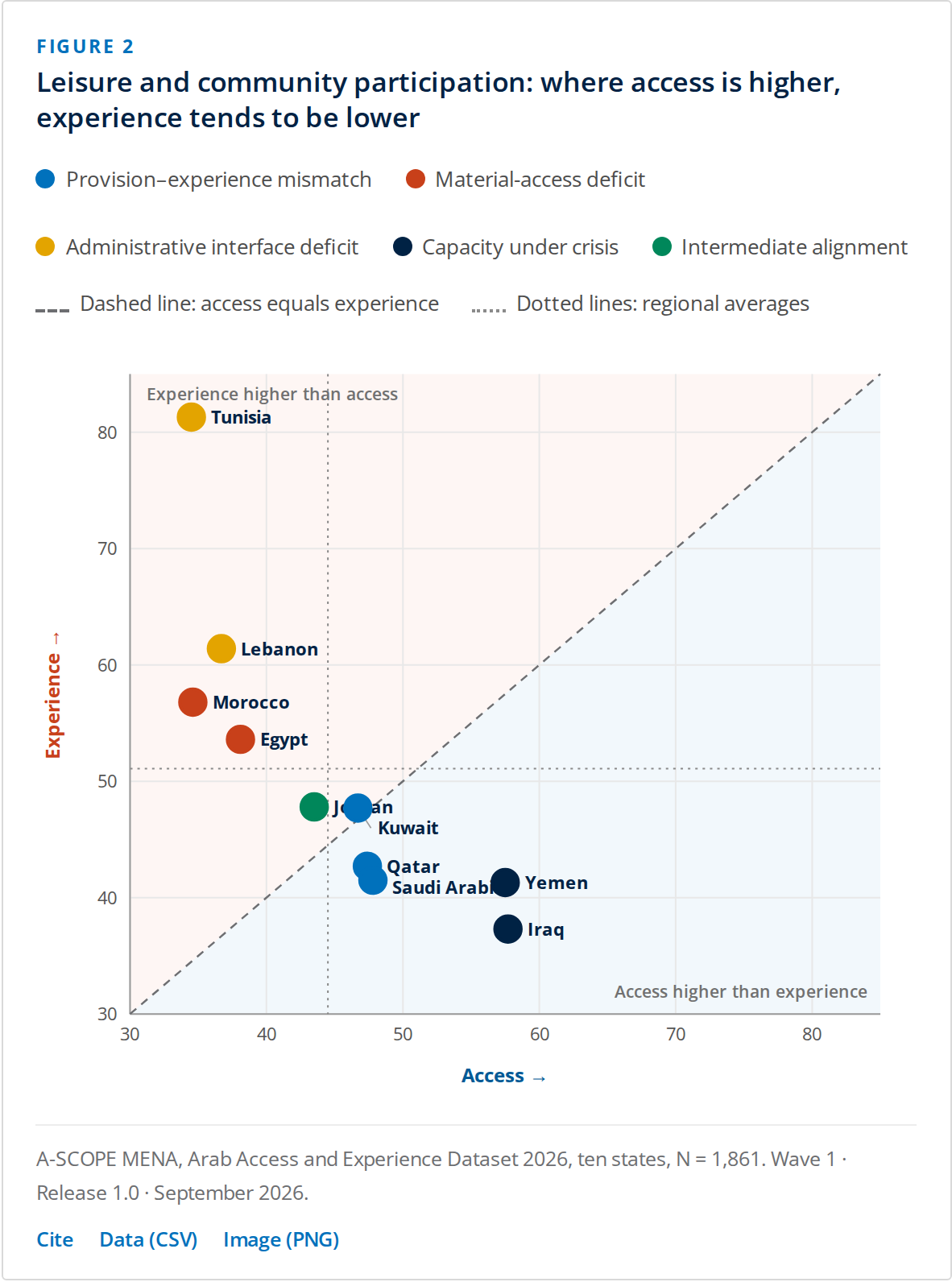
Bivariate distribution of access and experience
States are classified into terciles of access and of experience in this domain, relative to the other nine states, and shaded accordingly.
Source: A-SCOPE MENA, Arab Access and Experience Dataset 2026 · non-probability samples; scores describe respondents.
The ten states in this domain
Ranking
Presence of community groups, clubs and organisations, of leisure and sports facilities; membership of groups; unpaid help given to others; frequency of leisure activities.
Views on the range of opportunities to take part, to volunteer and to use leisure time; satisfaction with leisure activities.
Findings
Access ranges from 34.5 (Tunisia) to 57.7 (Iraq) and experience from 37.3 (Iraq) to 81.3 (Tunisia). Across states the two measures move in opposite directions (r = −0.82), the strongest inverse relationship in the sample.
Yemen and Iraq record membership and activity (57.5 and 57.7) that residents do not experience as satisfying (41.3 and 37.3). Tunisia, Lebanon, Morocco and Egypt record the reverse: limited recorded participation (34.5, 36.7, 34.6, 38.1) and much higher satisfaction (81.3, 61.4, 56.8, 53.6). The Tunisian gap, −46.8, is the largest negative gap in the sample.
Citizens voice
“I have no confidence in the work of NGOs”
Lebanon
“Providing assistance to those who need help”
Yemen
What respondents said they would change. Open-ended answers as transcribed in English by the survey team, lightly edited for punctuation; attributed by country only.
AccessExperienceDotted lines: regional averages
Sorted by the gap between access and experience.
Gulf and Arabian PeninsulaLevant and IraqNorth Africa
Dashed line: access equals experienceDotted lines: regional averages