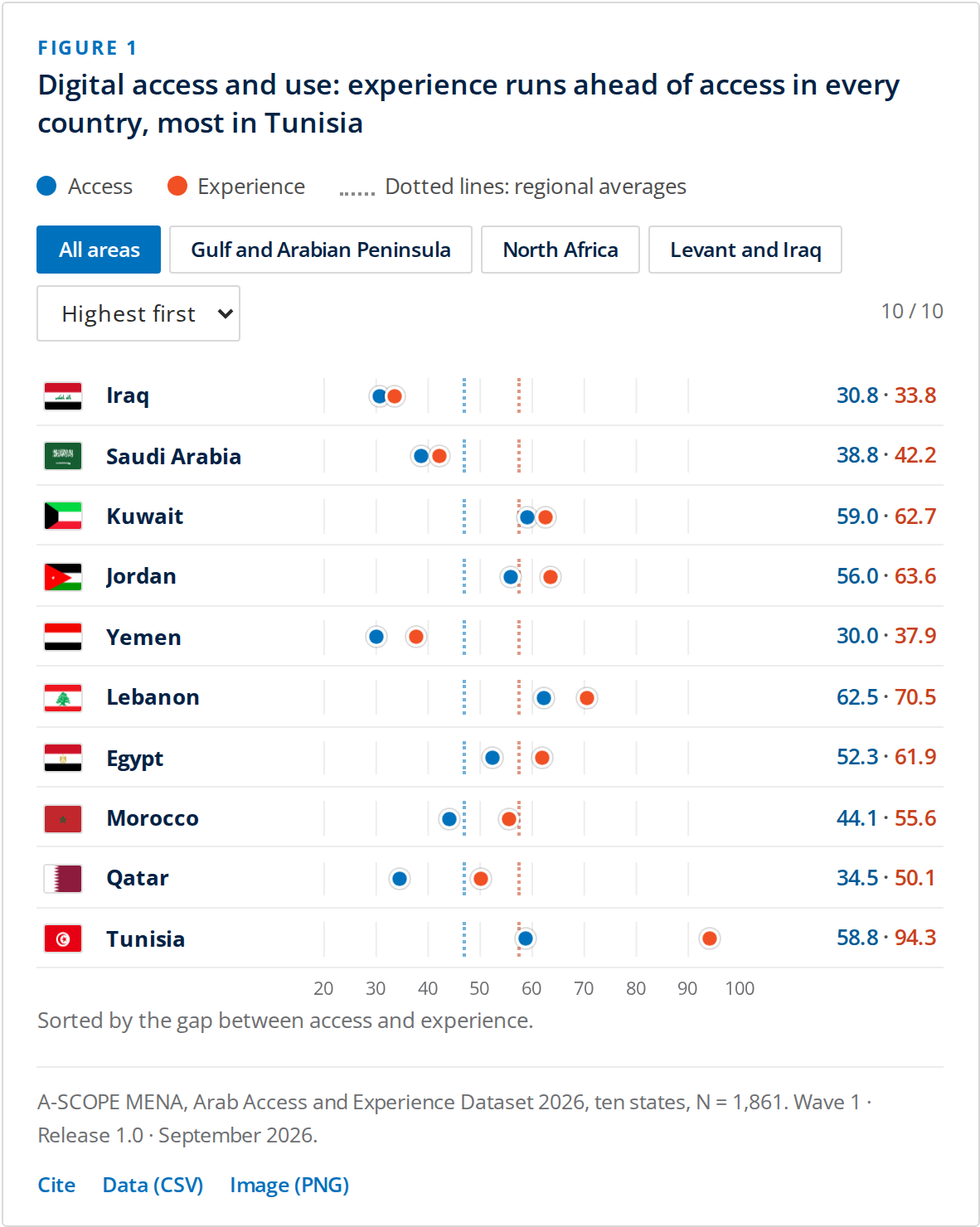
Access and experience by state
Each line connects the access score of a state (left) with its experience score (right). A downward slope indicates that access exceeds experience; an upward slope indicates the reverse. The gradient is proportional to the gap.
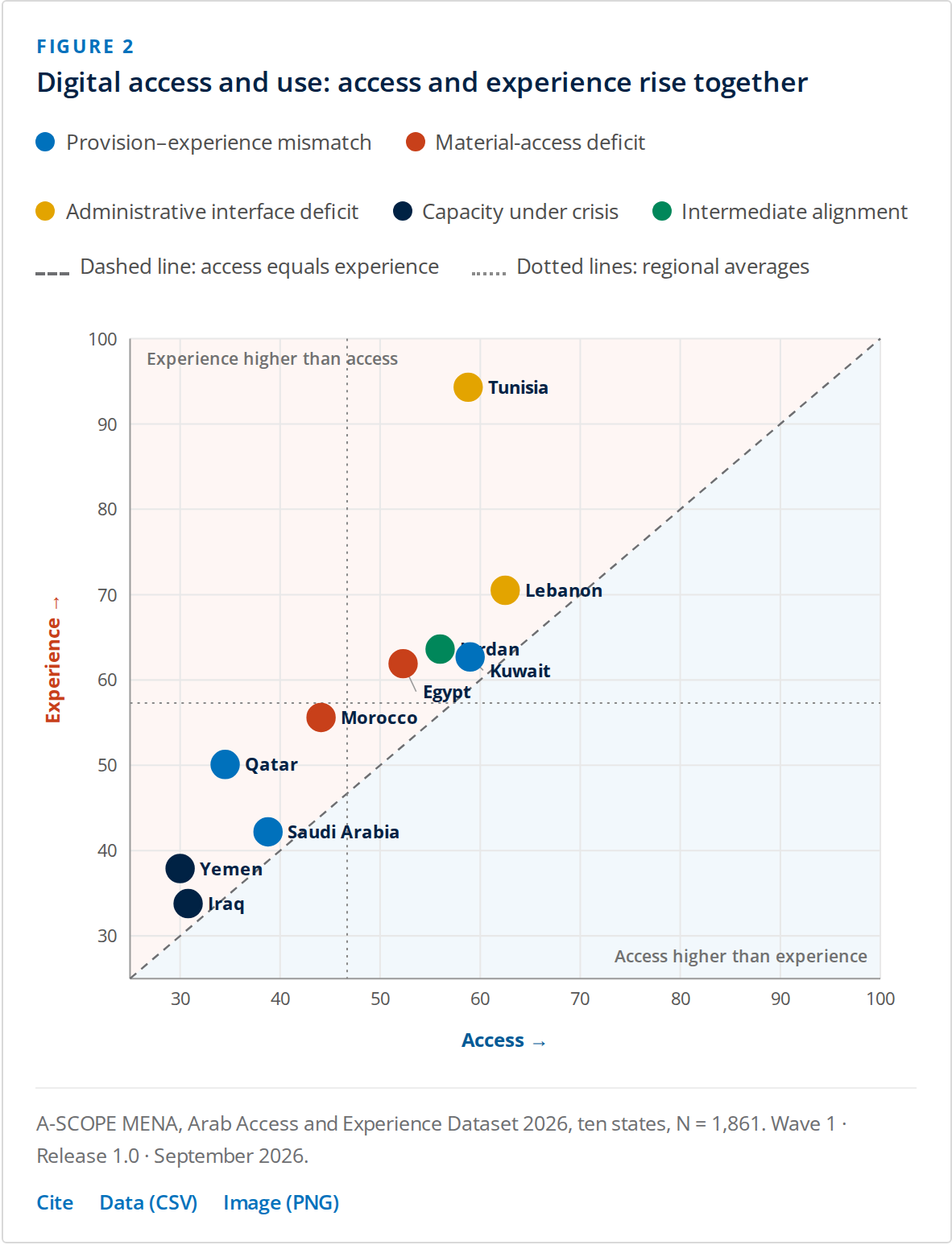
Bivariate distribution of access and experience
States are classified into terciles of access and of experience in this domain, relative to the other nine states, and shaded accordingly.
Source: A-SCOPE MENA, Arab Access and Experience Dataset 2026 · non-probability samples; scores describe respondents.
The ten states in this domain
Ranking
Internet use at home or elsewhere; household access to a computer and a mobile telephone; use of AI tools; use of the internet for essential information and social media; experience of hacking or blocking.
Satisfaction with internet access, views on opportunities to go online and on the range of opportunities available.
Findings
Digital access is the most dispersed domain (standard deviation 13.9). Tunisia (58.8 access, 94.3 experience) and Lebanon (62.5, 70.5) lead; Yemen (30.0, 37.9) and Iraq (30.8, 33.8) trail. Qatar (34.5) and Saudi Arabia (38.8) record low access.
It is the one domain in which experience exceeds access in every state, by 3 points in Iraq and by 35.5 in Tunisia.
Citizens voice
“Availability of internet everywhere”
Egypt
What respondents said they would change. Open-ended answers as transcribed in English by the survey team, lightly edited for punctuation; attributed by country only.
AccessExperienceDotted lines: regional averages
Sorted by the gap between access and experience.
Gulf and Arabian PeninsulaLevant and IraqNorth Africa
Dashed line: access equals experienceDotted lines: regional averages