مرصد الإدارة / Report 2026
From Provision to Experience
A Public Administration Analysis of Access to Services, Resources and Opportunities in the Arab States
Arab Access and Experience Index (AAEI) 2026 · Anis Ben BrikPDF

Arab Access and Experience Index (AAEI) 2026
From Provision to Experience
A Public Administration Analysis of Access to Services, Resources and Opportunities in the Arab States
Anis Ben Brik
2026
Arab Access and Experience Index (AAEI) 2026
From Provision to Experience
A Public Administration Analysis of Access to Services, Resources and Opportunities in the Arab States
Anis Ben Brik

From Provision to Experience. A Public Administration Analysis of Access to Services, Resources and Opportunities in the Arab States. Arab Access and Experience Index (AAEI) 2026.
Ben Brik, A. (2026). From Provision to Experience: A Public Administration Analysis of Access to Services, Resources and Opportunities in the Arab States. Arab Access and Experience Index (AAEI) 2026. مرصد الإدارة, Administration Observatory in the Arab Region.
This report was written by Anis Ben Brik. The A-SCOPE MENA instrument was developed with C. Taylor Brown (University of California, Berkeley). Qihao Liang (University of Michigan) contributed to data construction; Neil Gilbert (University of California, Berkeley) advised. The author thanks the respondents and the field teams. Responsibility for any error rests with the author.
© 2026 Anis Ben Brik. Version 1.0, September 2026. Licence: CC BY 4.0. Data, item specification and code are published with the report. The index describes what respondents report about their access to and experience of services, resources and opportunities. It does not measure administrative capacity, the performance of any government or the quality of any agency. Samples are non-probability samples; scores describe respondents, not national populations.
Contents
Figures
Figure 1. Most countries report more access than they rate positivelyFigure 2. From provision to experience: what the survey observesFigure 3. The gap between access and experience is widest in Yemen, Iraq, Saudi Arabia and QatarFigure 4. Access runs ahead of experience in seven of ten countriesFigure 5. Access and experience by country in each domain (1 of 2)Figure 6. Access and experience by country in each domain (2 of 2)Figure 7. Health and family relationships show the widest gaps; digital access shows the reverseFigure 8. Access exceeds experience in health and family relationships almost everywhereFigure 9. Service provision and assistance: where access is higher, experience tends to be lowerFigure 10. Civic participation and voice: where access is higher, experience tends to be lowerFigure 11. Five patterns of access and experienceTables
Table 1. Domains, categories and role of governmentTable 2. Sample and item response by stateTable 3. The Arab Access and Experience Index 2026Table 4. Domain means, gaps and correlationsTable 5. Iraq and Yemen: selected domainsTable 6. Five administrative challengesTable 7. Access by state and domainTable 8. Experience by state and domainTable 9. Domain scores by state (mean of the two measures)Foreword
مرصد الإدارة, the Administration Observatory in the Arab Region, publishes this report as the first release of the Arab Access and Experience Index. It replaces an earlier release that presented the same survey as a social inclusion index. The revision is both technical and conceptual.
Technically, the survey was re-scored from the raw country files against the questionnaire, with an explicit item specification and absolute scores; all ten states surveyed are reported, with the evidence base of each stated. Conceptually, the report no longer claims that the instrument measures social inclusion. It describes what the data record, access and experience across eleven domains, and reads the relation between them through a public administration lens.
Summary
Access and experience diverge.
Across the ten states the access and experience indices correlate at 0.45, a relationship carried by Tunisia, which records the highest value on both. Among the other nine states the correlation is 0.00.
Access usually runs ahead of experience.
In 74 of 110 state-by-domain cells access exceeds experience. The gap is largest in health and care (24.2 points on average) and in family and social relationships (19.4).
In three domains the measures move in opposite directions.
Leisure (r = −0.82), civic participation (−0.34) and service provision (−0.33): the states with the most recorded participation or assistance tend to be those whose residents value it least.
The weakest domains are service provision, civic participation and leisure.
Regional means of 45.9, 47.6 and 47.8. Service provision and education move against the index (r = −0.47 and −0.48): Tunisia, first overall, is last on both.
Five administrative challenges.
Provision–experience mismatch (Qatar, Saudi Arabia, Kuwait); material-access deficit (Morocco, Egypt); administrative interface deficit (Tunisia, Lebanon); capacity under crisis (Yemen, Iraq); intermediate alignment (Jordan).
The explanation is administrative, the evidence is descriptive.
The pattern is consistent with administrative capacity acting as a link between provision and experience between provision and experience. The data are cross-sectional and do not measure administrative capacity; the report states the proposition and marks every mechanism as an inference.
At a glance
Samples are not representative: scores describe respondents, not national populations. Comparisons are indicative and small differences carry no weight. See Data and methods.
Introduction: when access is not experience
The puzzle, the question and the argument of the report.
Governments can expand services, infrastructure and formal entitlements without producing a corresponding improvement in how residents experience them. The A-SCOPE MENA survey makes this visible for ten Arab states. It records, for eleven domains of everyday life, what residents report being able to obtain or take part in and how they evaluate it. Across the ten states the access and experience indices correlate at 0.45, and the relationship is carried by one state: without Tunisia, which records the highest value on both, the correlation is 0.00.
The report asks two questions. (i) How do access to and experience of services, resources and opportunities vary across Arab states and domains? (ii) What do divergences between the two reveal about the conditions under which public provision becomes access that people can use and value?
The argument is that the central administrative challenge is not only to provide more but to turn provision into services that people use and value. The survey observes the outcome of that process, not its workings. The report therefore treats the access–experience gap as a potential indicator of problems in delivery and states every administrative explanation as a proposition consistent with the data rather than a finding established by them.
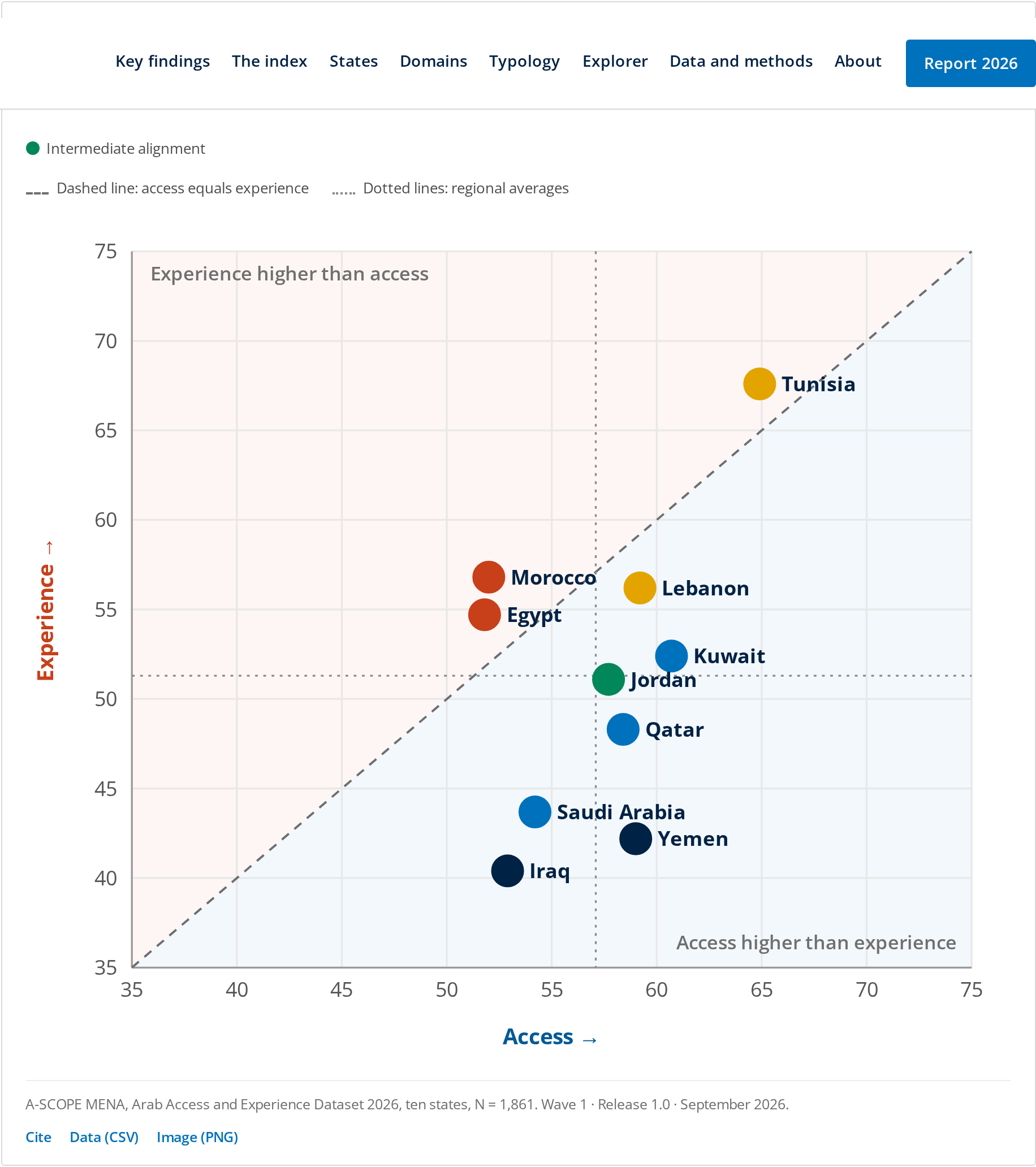
Provision–experience mismatchMaterial-access deficitAdministrative interface deficitCapacity under crisisIntermediate alignment
Dashed line: access equals experienceDotted lines: regional averages
What the survey measures
Access to what, and why the data are neither a social inclusion index nor a measure of service delivery.
The instrument adapts the Social and Community Opportunities Profile (Huxley et al., 2012) to the Arab region, with three domains added: civic participation and voice, environmental conditions, and service provision and assistance. For each domain it asks two kinds of question. Access records what respondents can obtain, use or take part in. Experience records how they evaluate it.
The eleven domains differ in kind. Some are public services; others are material conditions, basic conditions, or social and civic opportunities. Their common denominator is the ability of people to reach and benefit from the institutional, material, social and civic conditions of everyday life. The report does not describe the composite as social inclusion, a construct against which the instrument has not been validated in the region, and it does not describe it as a measure of service delivery, since family relationships and leisure are not public services.
The data do not measure bureaucratic capacity, efficiency, implementation, front-line discretion, procedures, service quality as delivered, responsiveness as practised, expenditure, staffing or organisational capability. These enter the analysis only as possible explanations and implications.
| Domain | Category | Role of government |
|---|---|---|
| Leisure and community participation | Social opportunities | Limited |
| Digital access and use | Basic conditions | Shared |
| Housing | Material conditions | Shared |
| Safety and policing | Basic conditions | Direct |
| Work, income and finance | Material conditions | Shared |
| Education and training | Public services | Direct |
| Health and care | Public services | Direct |
| Family and social relationships | Social opportunities | Limited |
| Civic participation and voice | Civic opportunities | Shared |
| Environmental conditions | Material conditions | Shared |
| Service provision and assistance | Public services | Direct |
Note. Annex C. Survey questions by domain
A public administration lens: turning provision into experience
The chain from provision to experience, four mechanisms and the limits of what the survey observes.
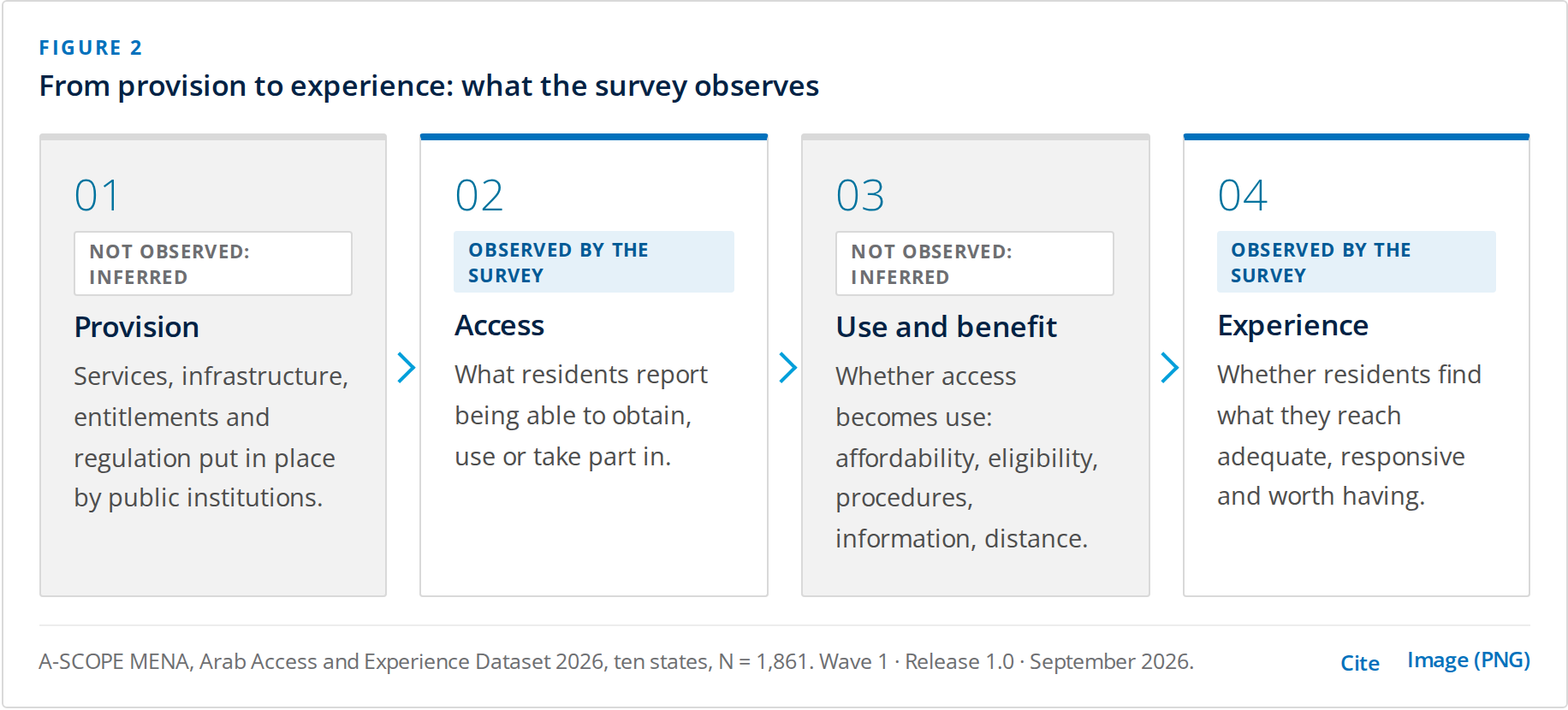
The report reads the survey through a chain of four stages: provision, access, use and benefit, experience. Provision is what public institutions put in place; access is what residents report being able to reach; use and benefit is whether access becomes use, given affordability, eligibility, procedures, information and distance; experience is whether residents find what they reach adequate and responsive. The survey observes access and experience.
Four conditions govern whether provision becomes experience. (i) Availability: is the service present? (ii) Accessibility: can people obtain it? (iii) Administrative responsiveness: can users navigate the system, complain and be answered? (iv) Experience: do people find it adequate and useful? The first is recorded in part by the access measure and the fourth by the experience measure; the second and third are where administrative explanations lie and are not observed.
The proposition that follows is that administrative capacity matters because it determines how far formal provision becomes effective and experience. The data are consistent with this proposition at the level of states and domains. They do not establish it.
Provision
Services, infrastructure, entitlements and regulation put in place by public institutions.
Access
What residents report being able to obtain, use or take part in.
Use and benefit
Whether access becomes use: affordability, eligibility, procedures, information, distance.
Experience
Whether residents find what they reach adequate, responsive and worth having.
Data and measurement
Instrument, sample, scoring and limitations.
Fieldwork took place in 2023 and 2024 in ten Arab League states, all of which are reported: Jordan (n = 299), Morocco (254), Egypt (253), Yemen (252), Tunisia (251), Kuwait (129), Qatar (119), Lebanon (103), Iraq (101) and Saudi Arabia (100), 1,861 respondents in total.
The raw country files were aligned to the questionnaire column by column. 188 items are scored: 120 on the access measure and 68 on the experience measure. Each item is assigned to a domain by its place in the questionnaire, rescaled to 0 to 100 in the direction of access or positive experience, with the direction taken from its response options. Codes for do not know and not applicable, and any value outside the documented response set, are missing; nothing is imputed. A domain score is the mean of its two measures; the index is the unweighted mean of the eleven domains.
Scores are absolute: 50 means that respondents on average sit at the midpoint of the items, and no state score depends on which other states are included. The limitations are material: non-probability samples of 100 to 299; a cross-sectional design; item response between 52 and 96 per cent; cultural differences in reporting satisfaction; two states affected by conflict during fieldwork; twelve Arab League states not covered.
The samples are not representative of national populations. The scores describe the respondents surveyed, cannot be generalised to the populations of the ten states, and should be read as exploratory and descriptive evidence, not as national estimates or measures of government performance. Annex A sets out the consequences for interpretation and the design of the next, representative wave.
| State | Area | n | Scored items answered (%) |
|---|---|---|---|
| Jordan | Levant and Iraq | 299 | 75 |
| Morocco | North Africa | 254 | 52 |
| Egypt | North Africa | 253 | 73 |
| Yemen | Gulf and Arabian Peninsula | 252 | 82 |
| Tunisia | North Africa | 251 | 96 |
| Kuwait | Gulf and Arabian Peninsula | 129 | 72 |
| Qatar | Gulf and Arabian Peninsula | 119 | 75 |
| Lebanon | Levant and Iraq | 103 | 75 |
| Iraq | Levant and Iraq | 101 | 77 |
| Saudi Arabia | Gulf and Arabian Peninsula | 100 | 80 |
The Arab Access and Experience Index
Results by state on the index, the access measure and the experience measure.
The index ranges from 66.2 (Tunisia) to 46.7 (Iraq) around a regional mean of 54.2. The spread between states, 19.5 points, is narrower than the spread between domains within most states, which runs from 16 points (Kuwait) to 56 (Tunisia).
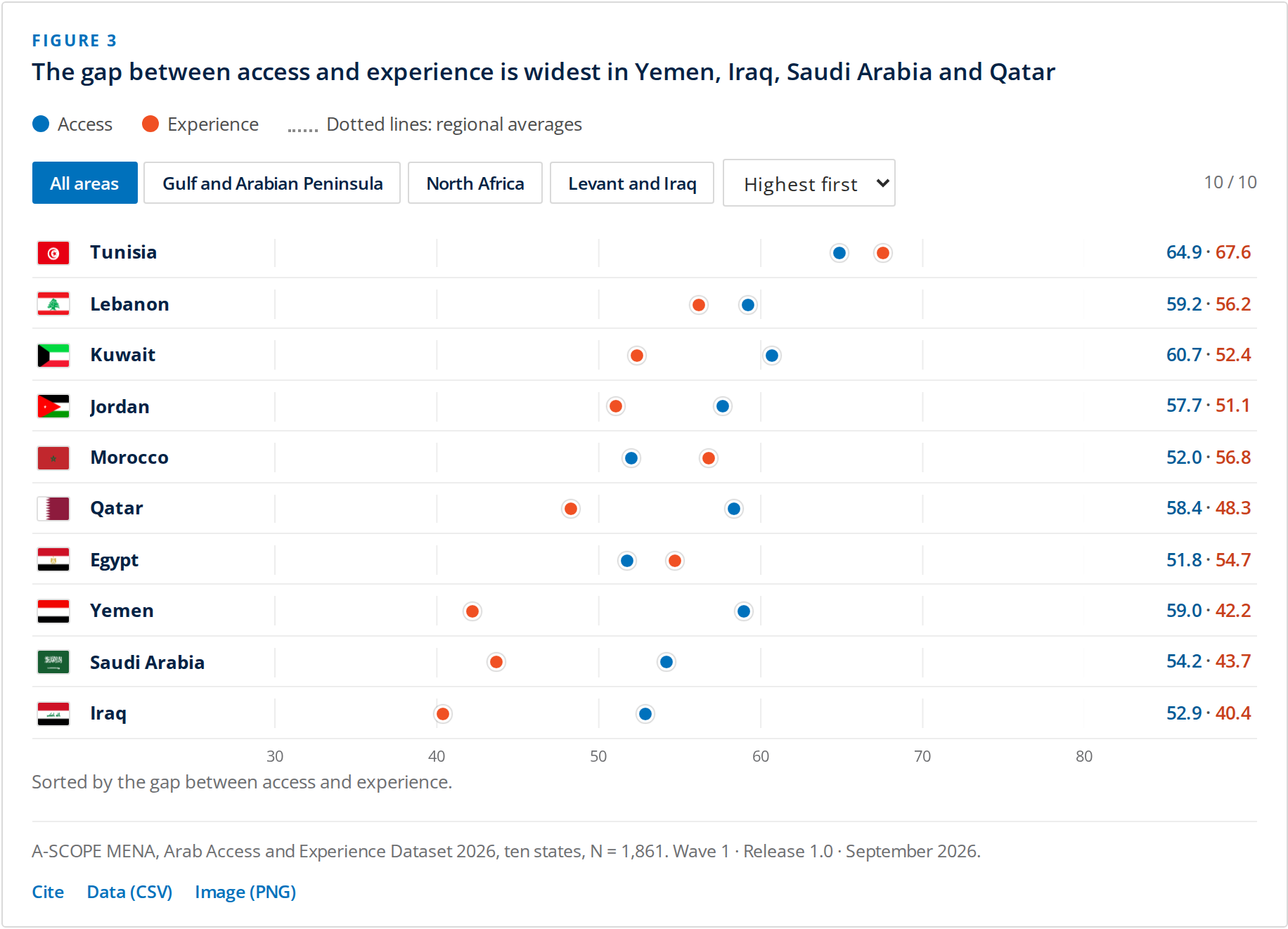
Tunisia is first on both measures (access 64.9, experience 67.6). Beyond it the measures rank the states differently. Kuwait, Lebanon and Yemen follow on access; Morocco, Lebanon and Egypt on experience. Yemen is fourth on access and ninth on experience; Morocco is ninth on access and second on experience.
The samples are not representative of national populations. The scores describe the respondents surveyed, cannot be generalised to the populations of the ten states, and should be read as exploratory and descriptive evidence, not as national estimates or measures of government performance. Annex A sets out the consequences for interpretation and the design of the next, representative wave.
| State | Position | Type | Index | Access | Experience | Access–experience gap | n |
|---|---|---|---|---|---|---|---|
| Tunisia | Above the regional mean | Administrative interface deficit | 66.2 | 64.9 | 67.6 | −2.7 | 251 |
| Lebanon | Above the regional mean | Administrative interface deficit | 57.7 | 59.2 | 56.2 | +3.0 | 103 |
| Kuwait | Above the regional mean | Provision–experience mismatch | 56.6 | 60.7 | 52.4 | +8.3 | 129 |
| Jordan | Near the regional mean | Intermediate alignment | 54.4 | 57.7 | 51.1 | +6.6 | 299 |
| Morocco | Near the regional mean | Material-access deficit | 54.4 | 52.0 | 56.8 | −4.8 | 254 |
| Qatar | Near the regional mean | Provision–experience mismatch | 53.4 | 58.4 | 48.3 | +10.1 | 119 |
| Egypt | Near the regional mean | Material-access deficit | 53.3 | 51.8 | 54.7 | −2.9 | 253 |
| Yemen | Below the regional mean | Capacity under crisis | 50.6 | 59.0 | 42.2 | +16.8 | 252 |
| Saudi Arabia | Below the regional mean | Provision–experience mismatch | 49.0 | 54.2 | 43.7 | +10.5 | 100 |
| Iraq | Below the regional mean | Capacity under crisis | 46.7 | 52.9 | 40.4 | +12.5 | 101 |
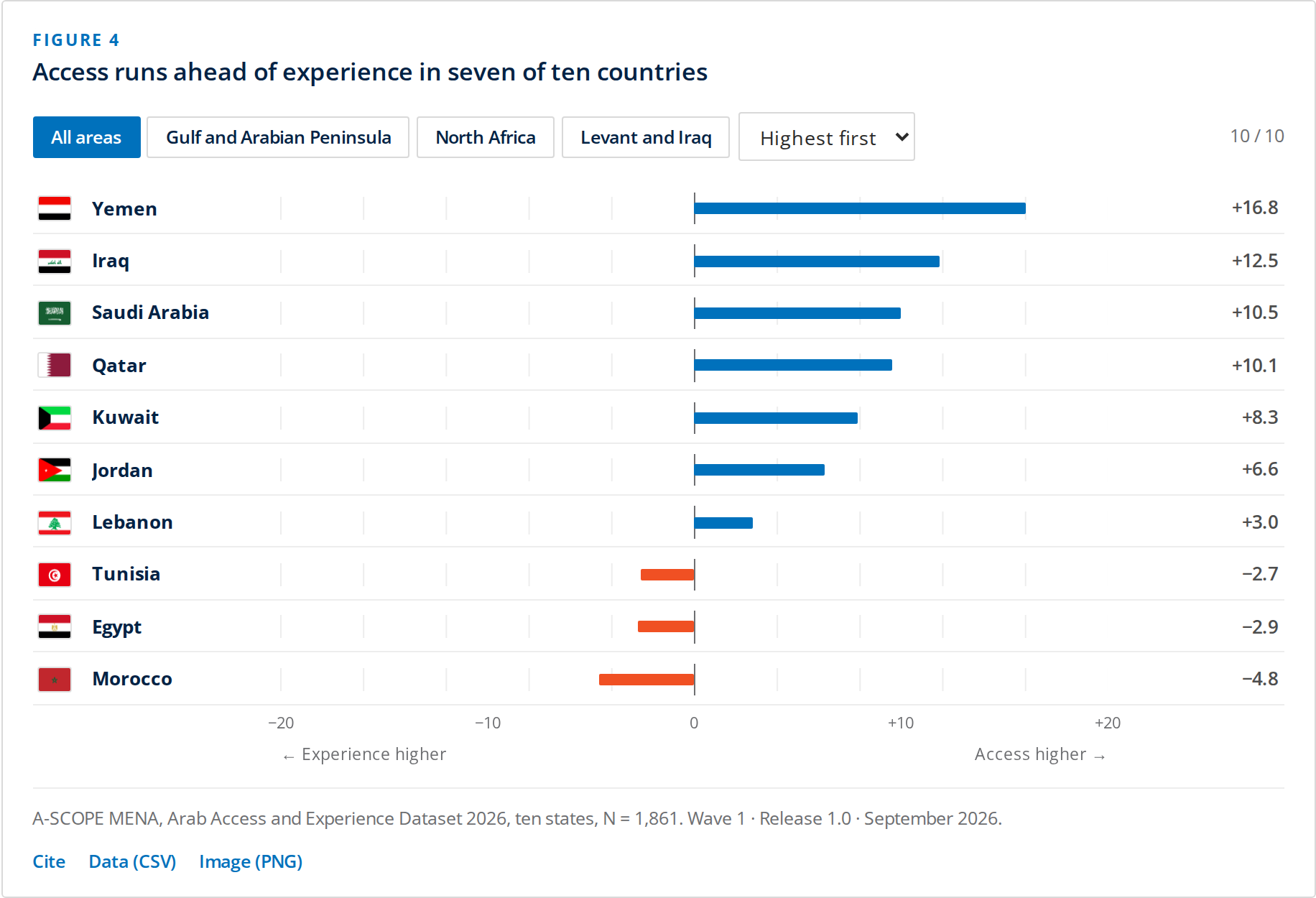
Note. Access–experience gap = access minus experience. Positive: access exceeds experience. Negative: experience exceeds access. Samples are not representative: scores describe respondents, not national populations. Comparisons are indicative and small differences carry no weight. See Data and methods.
AccessExperienceDotted lines: regional averages
Sorted by the gap between access and experience.
Variation across domains
Eleven domains, their role of government and where access and experience diverge.
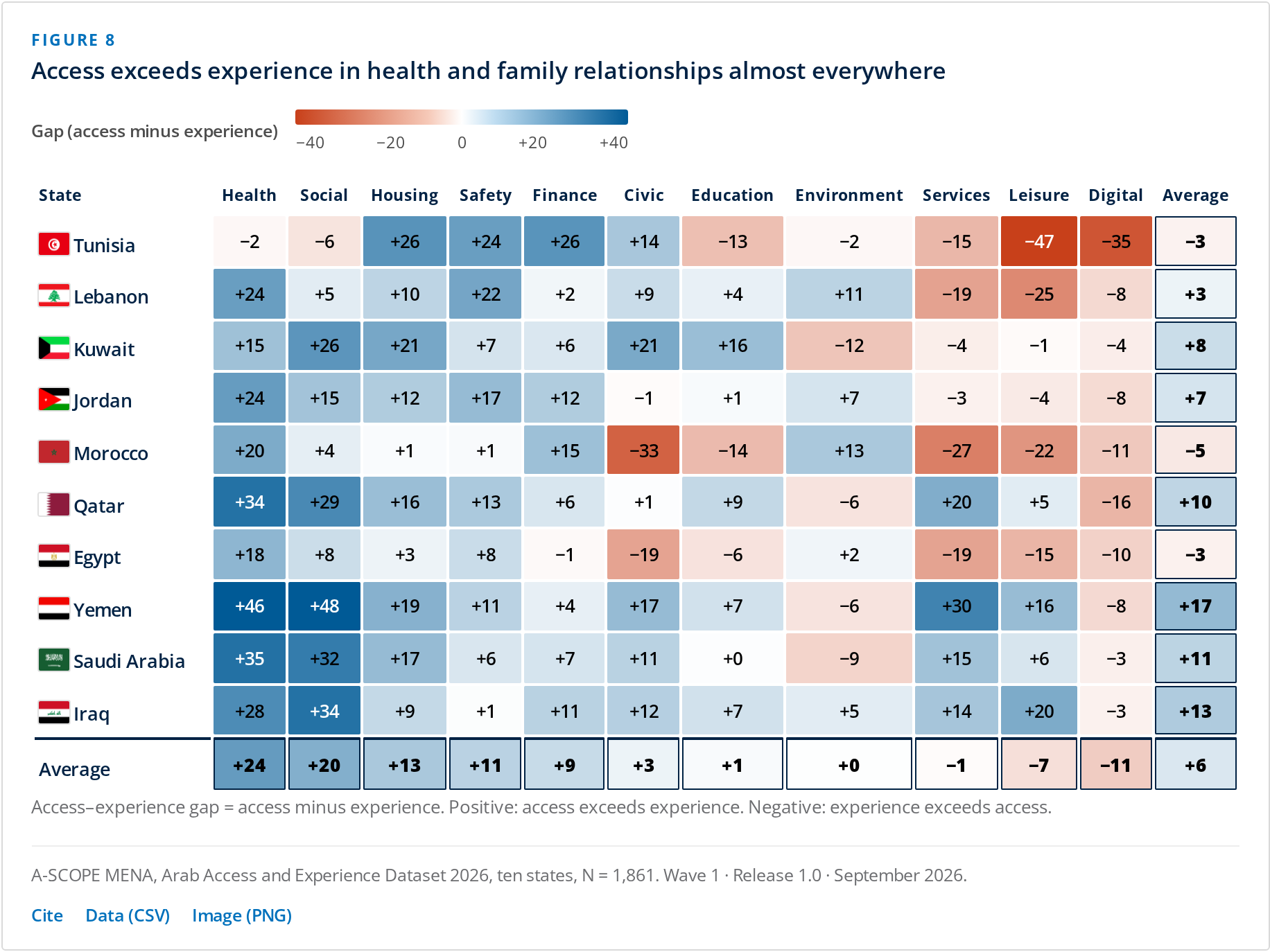
The strongest domains are family and social relationships (65.3), safety (61.2), health and care (60.3) and housing (60.2). The weakest are service provision (45.9), civic participation (47.6) and leisure (47.8). Several domains carry the ranking of states: family relationships (r = 0.93), safety (0.92), digital access (0.91) and environment (0.90). Education (−0.48) and service provision (−0.47) move against the index: the states that score highest overall tend to score lowest on the two domains of direct public provision.
| Domain | Access | Experience | Access–experience gap | r (A, E) | r (I) |
|---|---|---|---|---|---|
| Leisure and community participation | 44.5 | 51.1 | −6.6 | −0.82 | 0.74 |
| Digital access and use | 46.7 | 57.3 | −10.6 | 0.86 | 0.91 |
| Housing | 66.9 | 53.5 | +13.4 | 0.65 | 0.82 |
| Safety and policing | 66.6 | 55.8 | +10.8 | 0.89 | 0.92 |
| Work, income and finance | 59.2 | 50.4 | +8.8 | 0.85 | 0.87 |
| Education and training | 51.2 | 50.1 | +1.1 | 0.74 | −0.48 |
| Health and care | 72.4 | 48.2 | +24.2 | 0.22 | 0.84 |
| Family and social relationships | 75.1 | 55.6 | +19.5 | 0.08 | 0.93 |
| Civic participation and voice | 49.1 | 46.1 | +3.0 | −0.34 | 0.56 |
| Environmental conditions | 50.7 | 50.4 | +0.3 | 0.50 | 0.90 |
| Service provision and assistance | 45.5 | 46.4 | −0.9 | −0.33 | −0.47 |
Note. r (A, E): How closely access and experience move together across countries (correlation). r (I): How closely this domain follows the overall index (correlation).
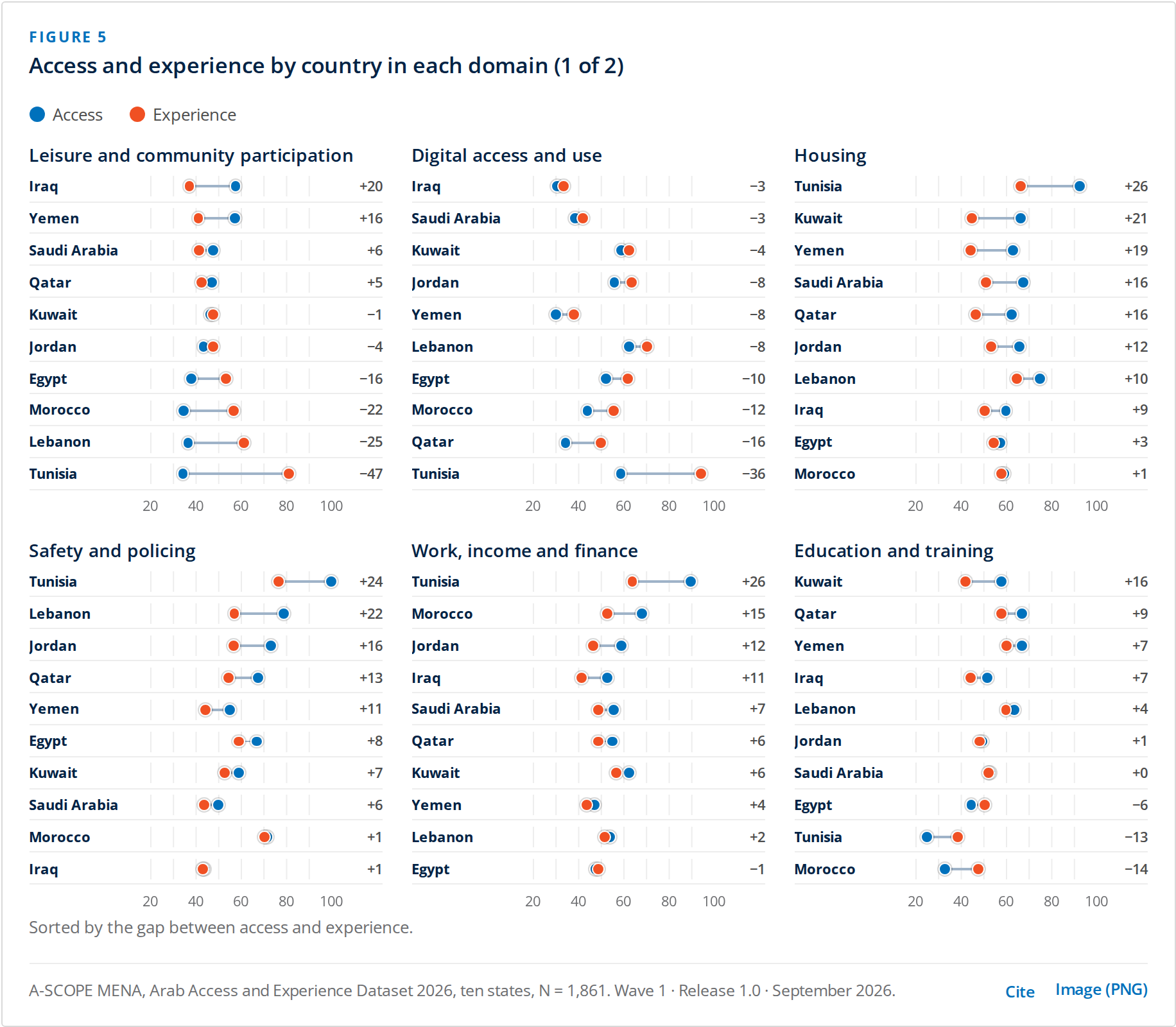
AccessExperience
Leisure and community participation
Digital access and use
Housing
Safety and policing
Work, income and finance
Education and training
Sorted by the gap between access and experience.
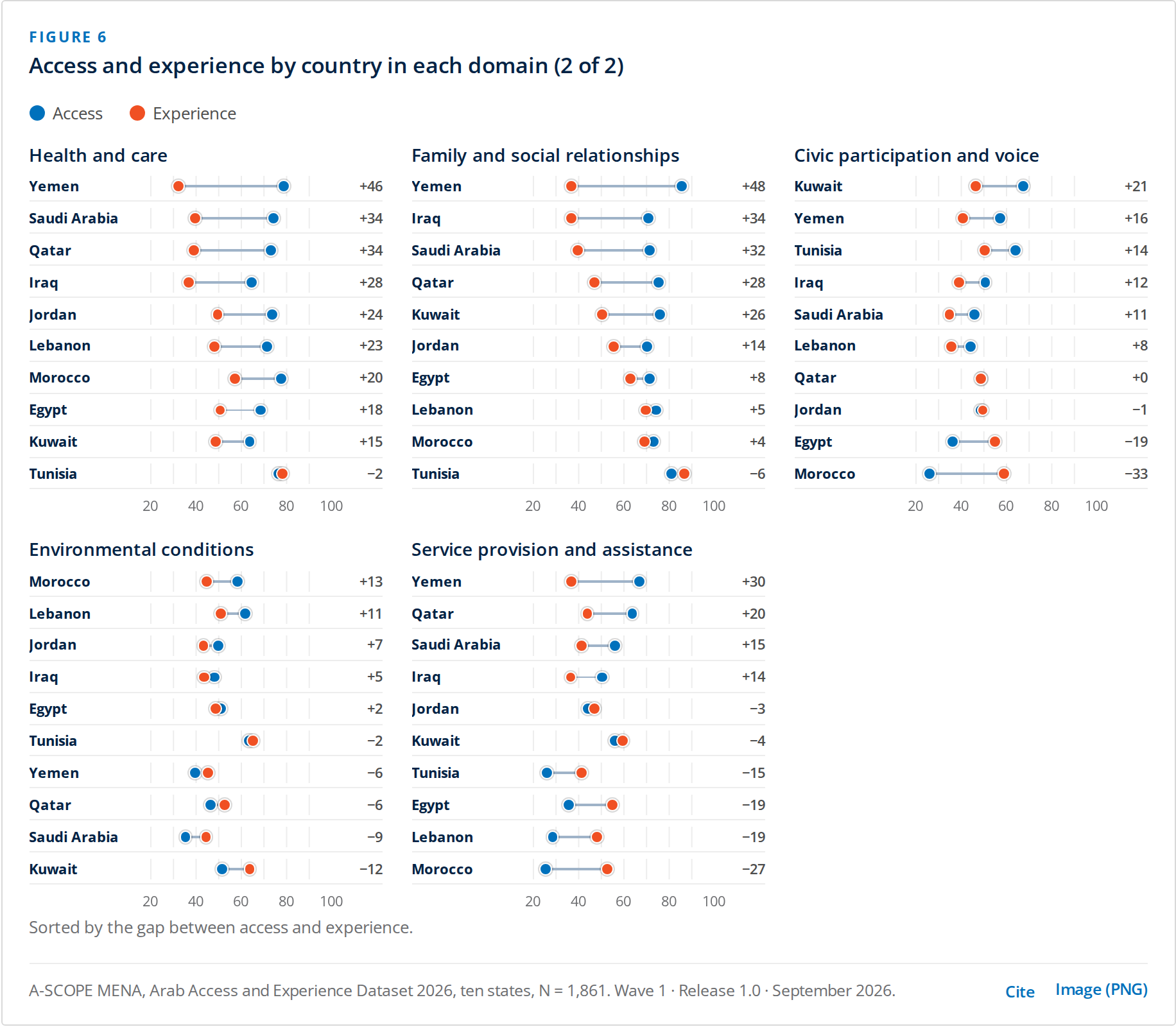
AccessExperience
Health and care
Family and social relationships
Civic participation and voice
Environmental conditions
Service provision and assistance
Sorted by the gap between access and experience.
§d-leisure§6.1 Leisure and community participation
Role of government: Limited · Social opportunities
Presence of community groups, clubs and organisations, of leisure and sports facilities; membership of groups; unpaid help given to others; frequency of leisure activities.
Views on the range of opportunities to take part, to volunteer and to use leisure time; satisfaction with leisure activities.
Access ranges from 34.5 (Tunisia) to 57.7 (Iraq) and experience from 37.3 (Iraq) to 81.3 (Tunisia). Across states the two measures move in opposite directions (r = −0.82), the strongest inverse relationship in the index.
Yemen and Iraq record membership and activity (57.5 and 57.7) that residents do not experience as satisfying (41.3 and 37.3). Tunisia, Lebanon, Morocco and Egypt record the reverse: limited recorded participation (34.5, 36.7, 34.6, 38.1) and much higher satisfaction (81.3, 61.4, 56.8, 53.6). The Tunisian gap, −46.8, is the largest negative gap in the index.
Citizens voice
“I have no confidence in the work of NGOs”
Lebanon
“Providing assistance to those who need help”
Yemen
What respondents said they would change. Open-ended answers as transcribed in English by the survey team, lightly edited for punctuation; attributed by country only.
§d-digital§6.2 Digital access and use
Role of government: Shared · Basic conditions
Internet use at home or elsewhere; household access to a computer and a mobile telephone; use of AI tools; use of the internet for essential information and social media; experience of hacking or blocking.
Satisfaction with internet access, views on opportunities to go online and on the range of opportunities available.
Digital access is the most dispersed domain (standard deviation 13.9) and closely tied to the index (r = 0.91). Tunisia (58.8 access, 94.3 experience) and Lebanon (62.5, 70.5) lead; Yemen (30.0, 37.9) and Iraq (30.8, 33.8) trail. Qatar (34.5) and Saudi Arabia (38.8) record low access.
It is the one domain in which experience exceeds access in every state, by 3 points in Iraq and by 35.5 in Tunisia.
Citizens voice
“Availability of internet everywhere”
Egypt
What respondents said they would change. Open-ended answers as transcribed in English by the survey team, lightly edited for punctuation; attributed by country only.
§d-housing§6.3 Housing
Role of government: Shared · Material conditions
Availability of suitable housing at an affordable price in the preferred area; a self-contained dwelling.
Feelings about the accommodation, the preference to stay in the area, views on opportunities to find suitable housing and on the range available.
Access is high in every state (57.3 in Egypt to 92.6 in Tunisia) and exceeds experience in all ten, by 0.9 points in Morocco and by 15.8 to 26.2 points in Qatar, Saudi Arabia, Yemen, Kuwait and Tunisia.
Tunisia leads on both measures (92.6 and 66.4), Lebanon is second (75.2 and 64.8); Kuwait records a large gap (66.4 and 45.0).
§d-safety§6.4 Safety and policing
Role of government: Direct · Basic conditions
Walking alone in the area after dark; victimisation by crime or assault in the past year.
Feeling safe after dark and in the area; satisfaction with public and personal safety; the expected likelihood of police protection, of abuse of power and of prosecution of officers.
Access exceeds experience in all ten states, from 0.6 points in Iraq to 23.6 in Tunisia and 21.7 in Lebanon. Every Tunisian respondent reports walking alone after dark and no victimisation (access 100.0). Morocco follows (71.4 and 70.3); Iraq is lowest on both measures (43.8 and 43.2).
Safety is one of the domains that carry the ranking of states (r = 0.92).
§d-finance§6.5 Work, income and finance
Role of government: Shared · Material conditions
Employment status; arrears on rent or mortgage; ability to borrow a small sum; a bank near the home and its use for saving or credit.
Feelings about the current job or about not working, how well the household is managing, ease of covering housing costs, views on opportunities to find work and to increase income, and feelings about personal and household finances.
Access ranges from 47.4 (Yemen) to 89.9 (Tunisia); experience from 41.7 (Iraq) to 63.9 (Tunisia). Access exceeds experience in nine states, most in Tunisia (26.0), Morocco (15.3) and Jordan (12.4); Egypt is the exception (47.9 and 49.1).
Citizens voice
“I want to find a job close to my residence”
Yemen
“Providing more opportunities for young people”
Egypt
What respondents said they would change. Open-ended answers as transcribed in English by the survey team, lightly edited for punctuation; attributed by country only.
§d-education§6.6 Education and training
Role of government: Direct · Public services
Qualifications held; enrolment in a course in the past year; adult learning and job-related training; expected future learning.
Views on the availability of educational opportunities, feelings about the range available and about their own education and training.
Yemen (67.2) and Qatar (67.2) record the highest access; Tunisia (25.3) and Morocco (33.1) the lowest. Tunisia also records the lowest experience (38.7) and the lowest domain score in the sample (32.0). Kuwait records high access (57.8) with low experience (42.0).
The domain moves against the index (r = −0.48): the states that score highest overall tend to score low on education.
Citizens voice
“There is no money to cover the costs”
Qatar
“Reform of the educational organization”
Jordan
What respondents said they would change. Open-ended answers as transcribed in English by the survey team, lightly edited for punctuation; attributed by country only.
§d-health§6.7 Health and care
Role of government: Direct · Public services
Self-rated health; limitation of work or daily activity by physical health.
Mood over the past four weeks; feelings about physical and mental health; views on opportunities to improve health and on the range available.
Health shows the largest access–experience gap of any domain: access averages 72.4 and experience 48.2. Access exceeds experience in nine states, by 15.1 points in Kuwait to 46.1 in Yemen (78.8 and 32.7); Tunisia is the exception (76.8 and 78.4).
Experience ranks the states: Tunisia (78.4), Morocco (57.4) and Egypt (50.9) lead; Yemen (32.7), Iraq (36.9), Qatar (39.0) and Saudi Arabia (39.8) trail.
Citizens voice
“The presence of doctors in all areas”
Egypt
“The presence of government hospitals”
Yemen
What respondents said they would change. Open-ended answers as transcribed in English by the survey team, lightly edited for punctuation; attributed by country only.
§d-social§6.8 Family and social relationships
Role of government: Limited · Social opportunities
Contact with parents, adult children, children and other relatives by visit, telephone and online; visits with friends and neighbours; going out.
Satisfaction with contact and relationships with family, with friendships and with opportunities to make friends and to meet people; feeling part of the community.
Contact is high in every state (70.3 in Jordan to 85.5 in Yemen). Experience ranges from 87.0 (Tunisia), 69.7 (Lebanon) and 69.2 (Morocco) to 37.1 (Yemen) and 36.9 (Iraq). The gap exceeds 25 points in Yemen (48.4), Iraq, Saudi Arabia, Qatar and Kuwait; in Tunisia experience exceeds contact.
The domain is the one most closely tied to the index (r = 0.93).
Citizens voice
“A place with new and different activities”
Egypt
What respondents said they would change. Open-ended answers as transcribed in English by the survey team, lightly edited for punctuation; attributed by country only.
§d-civic§6.9 Civic participation and voice
Role of government: Shared · Civic opportunities
Civic events and organisations near the home and attendance or membership; perceived freedoms of expression, organisation, assembly, media and internet; opportunities to influence government decisions and having done so.
Views on opportunities to attend civic events, to join organisations and to influence government; feelings about these opportunities; expected accountability of officials and influence of criminal organisations.
The second weakest domain in the region (mean 47.6). Tunisia (57.4) and Kuwait (57.3) lead; Kuwait records the highest access (67.8). Morocco records the lowest access (26.5) and the highest experience (59.3), a gap of −32.8. Lebanon records the lowest domain score (40.2).
Across states access and experience move in opposite directions (r = −0.34).
Citizens voice
“Get the opinion of citizens on this matter”
Egypt
“There are no effective methods in this country”
Jordan
What respondents said they would change. Open-ended answers as transcribed in English by the survey team, lightly edited for punctuation; attributed by country only.
§d-environment§6.10 Environmental conditions
Role of government: Shared · Material conditions
Having been affected by natural disasters or pollution in the past five years, six months and three months; preparedness for future disasters.
Views on the actions taken to recover from disasters and to deal with pollution, and feelings about the range of actions taken.
Tunisia (63.6), Lebanon (61.8) and Morocco (58.4) record the least exposure; Saudi Arabia (35.6) and Yemen (39.7) the most. Experience of the response ranges from 43.5 (Jordan) to 65.2 (Tunisia) and 63.9 (Kuwait).
Tunisia, Kuwait, Qatar, Yemen and Saudi Arabia rate the response above their exposure; Morocco, Lebanon, Jordan, Iraq and Egypt the reverse.
Citizens voice
“Installing filters on the smokestack”
Saudi Arabia
“Establish strong laws and punishment”
Egypt
What respondents said they would change. Open-ended answers as transcribed in English by the survey team, lightly edited for punctuation; attributed by country only.
§d-services§6.11 Service provision and assistance
Role of government: Direct · Public services
Eligibility for and receipt of government social assistance and assistance from non-governmental or charitable organisations; eligibility for and receipt of legal aid.
Views on the assistance and legal aid received and on the range of opportunities to obtain them; the expected likelihood of obtaining social assistance and legal aid without a bribe or informal payment.
The weakest domain in the region (mean 45.9). Kuwait (57.9) and Qatar (54.0) lead; Tunisia (34.0), Lebanon (38.5) and Morocco (39.2) trail. The domain moves against the index (r = −0.47): Tunisia and Lebanon, first and second overall, are last and second last on services.
Access and experience move in opposite directions across states (r = −0.33). Yemen records the highest access (66.8), reflecting receipt of assistance by 158 of 252 respondents, with low experience (36.8); Morocco, Tunisia and Lebanon record the lowest access (25.8, 26.5 and 28.8).
Citizens voice
“Facilities and development of services”
Egypt
What respondents said they would change. Open-ended answers as transcribed in English by the survey team, lightly edited for punctuation; attributed by country only.
The access–experience gap
High access with low experience, low access with high experience.
Access exceeds experience in 74 of 110 state-by-domain cells. The gap is consistent in four domains: housing (mean +13.5) and safety (+10.8) show access above experience in all ten states, health and care (+24.2) and family relationships (+19.4) in nine of ten, Tunisia being the exception. Digital access shows the opposite in all ten states (mean −10.6).
Two patterns matter for administration. High access with low experience appears most sharply in Yemen (+16.8 on the index), Iraq (+12.5), Saudi Arabia (+10.5) and Qatar (+10.1). Low access with high experience appears in Morocco (−4.8), Egypt (−2.9) and Tunisia (−2.7), and in particular domains: leisure in Tunisia (−46.8), digital access in Tunisia (−35.5), civic participation in Morocco (−32.8), services in Morocco (−26.8), leisure in Lebanon (−24.7).
Neither pattern can be read from one measure alone. A satisfaction survey would place Morocco second in the region; a coverage survey would place Yemen fourth. Only the two measures read side by side show where provision is not turned into experience, and where satisfaction masks a deficit.
AccessExperience
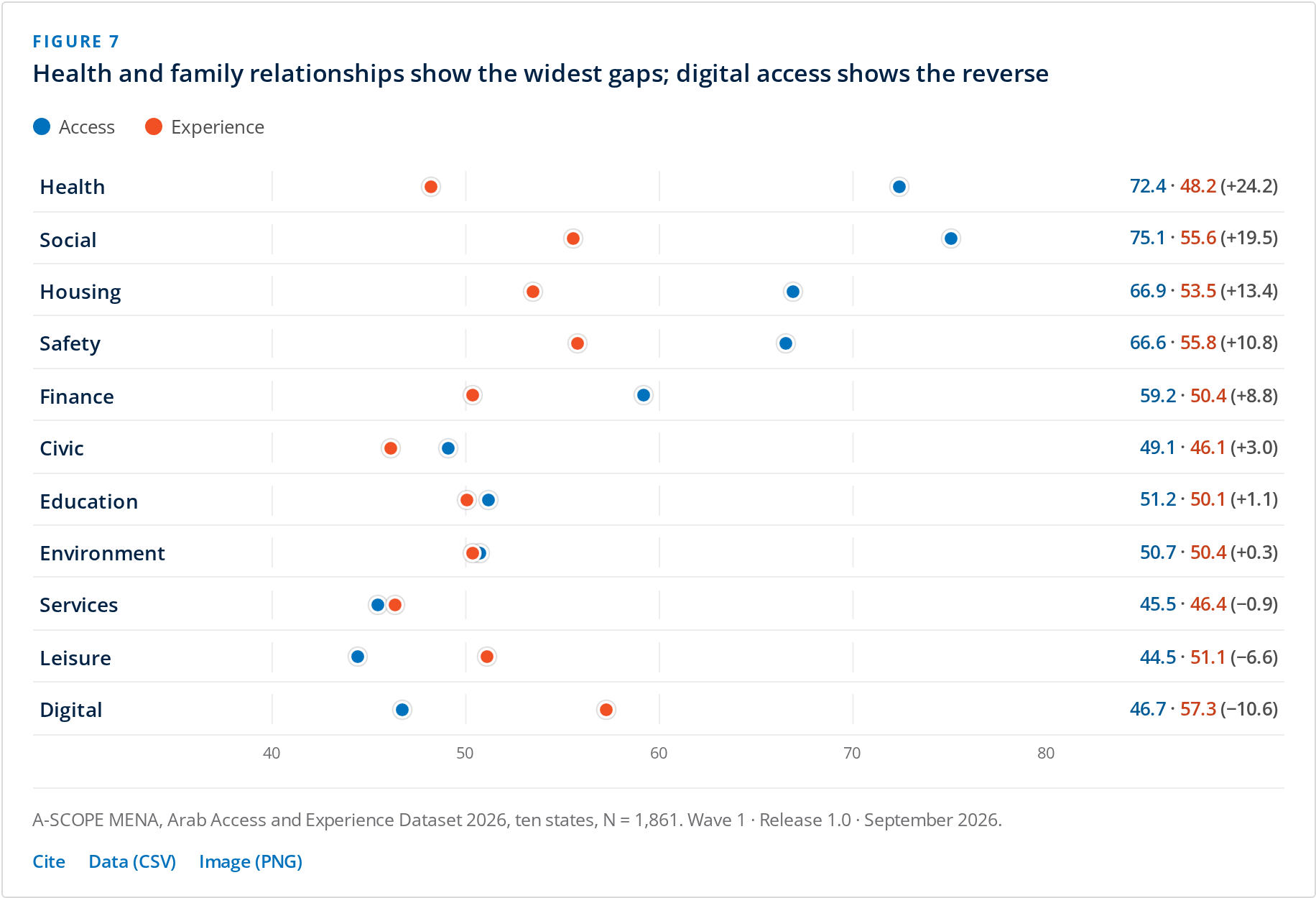
| State | Health | Social | Housing | Safety | Finance | Civic | Education | Environment | Services | Leisure | Digital | Average |
|---|---|---|---|---|---|---|---|---|---|---|---|---|
| Tunisia | −2 | −6 | +26 | +24 | +26 | +14 | −13 | −2 | −15 | −47 | −36 | −3 |
| Lebanon | +23 | +5 | +10 | +22 | +2 | +8 | +4 | +11 | −19 | −25 | −8 | +3 |
| Kuwait | +15 | +26 | +21 | +7 | +6 | +21 | +16 | −12 | −4 | −1 | −4 | +8 |
| Jordan | +24 | +14 | +12 | +16 | +12 | −1 | +1 | +7 | −3 | −4 | −8 | +7 |
| Morocco | +20 | +4 | +1 | +1 | +15 | −33 | −14 | +13 | −27 | −22 | −12 | −5 |
| Qatar | +34 | +28 | +16 | +13 | +6 | +0 | +9 | −6 | +20 | +5 | −16 | +10 |
| Egypt | +18 | +8 | +3 | +8 | −1 | −19 | −6 | +2 | −19 | −16 | −10 | −3 |
| Yemen | +46 | +48 | +19 | +11 | +4 | +16 | +7 | −6 | +30 | +16 | −8 | +17 |
| Saudi Arabia | +34 | +32 | +16 | +6 | +7 | +11 | +0 | −9 | +15 | +6 | −3 | +10 |
| Iraq | +28 | +34 | +9 | +1 | +11 | +12 | +7 | +5 | +14 | +20 | −3 | +12 |
| Average | +24 | +20 | +13 | +11 | +9 | +3 | +1 | +0 | −1 | −7 | −11 | +6 |
Access–experience gap = access minus experience. Positive: access exceeds experience. Negative: experience exceeds access.
Service provision, voice and administrative responsiveness
The two domains closest to the administrative interface.
Service provision and civic participation are the domains in which public administration is measured most directly: receipt of social assistance and legal aid, the expectation of obtaining them without informal payment, opportunities to influence government and the expected accountability of officials. In both, access and experience move in opposite directions across states (r = −0.33 and −0.34).
Tunisia and Lebanon, first and second on the index, are last and second last on service provision; Lebanon is last on civic participation. Morocco records the lowest access in the sample on services (25.8) and civic participation (26.5). Where material and social conditions are strong and these domains weak, the pattern is consistent with a deficit at the administrative interface: procedures, eligibility, information, complaint handling and channels of voice. The survey does not observe these directly.
Provision–experience mismatchMaterial-access deficitAdministrative interface deficitCapacity under crisisIntermediate alignment
Dashed line: access equals experienceDotted lines: regional averages
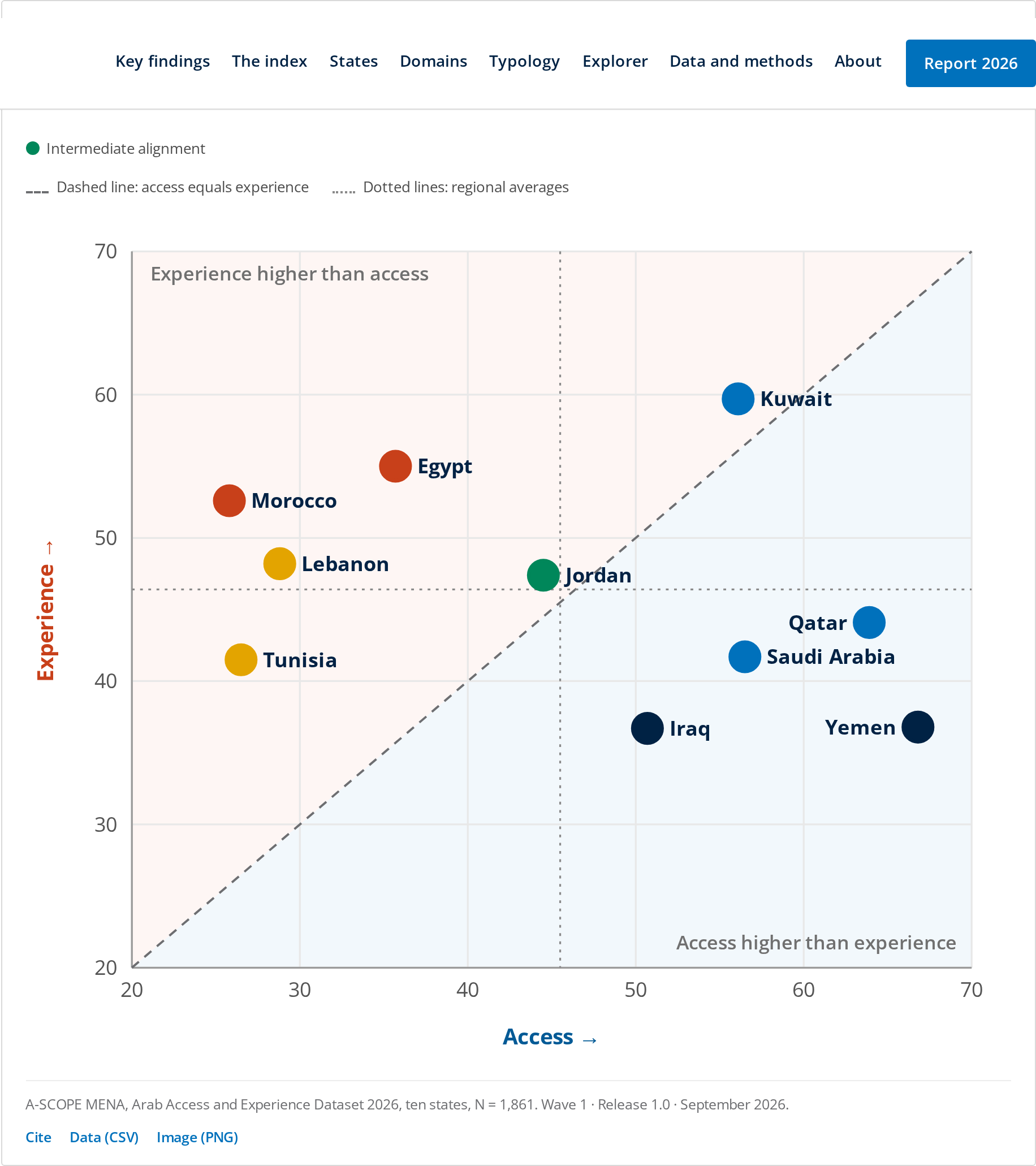
Provision–experience mismatchMaterial-access deficitAdministrative interface deficitCapacity under crisisIntermediate alignment
Dashed line: access equals experienceDotted lines: regional averages
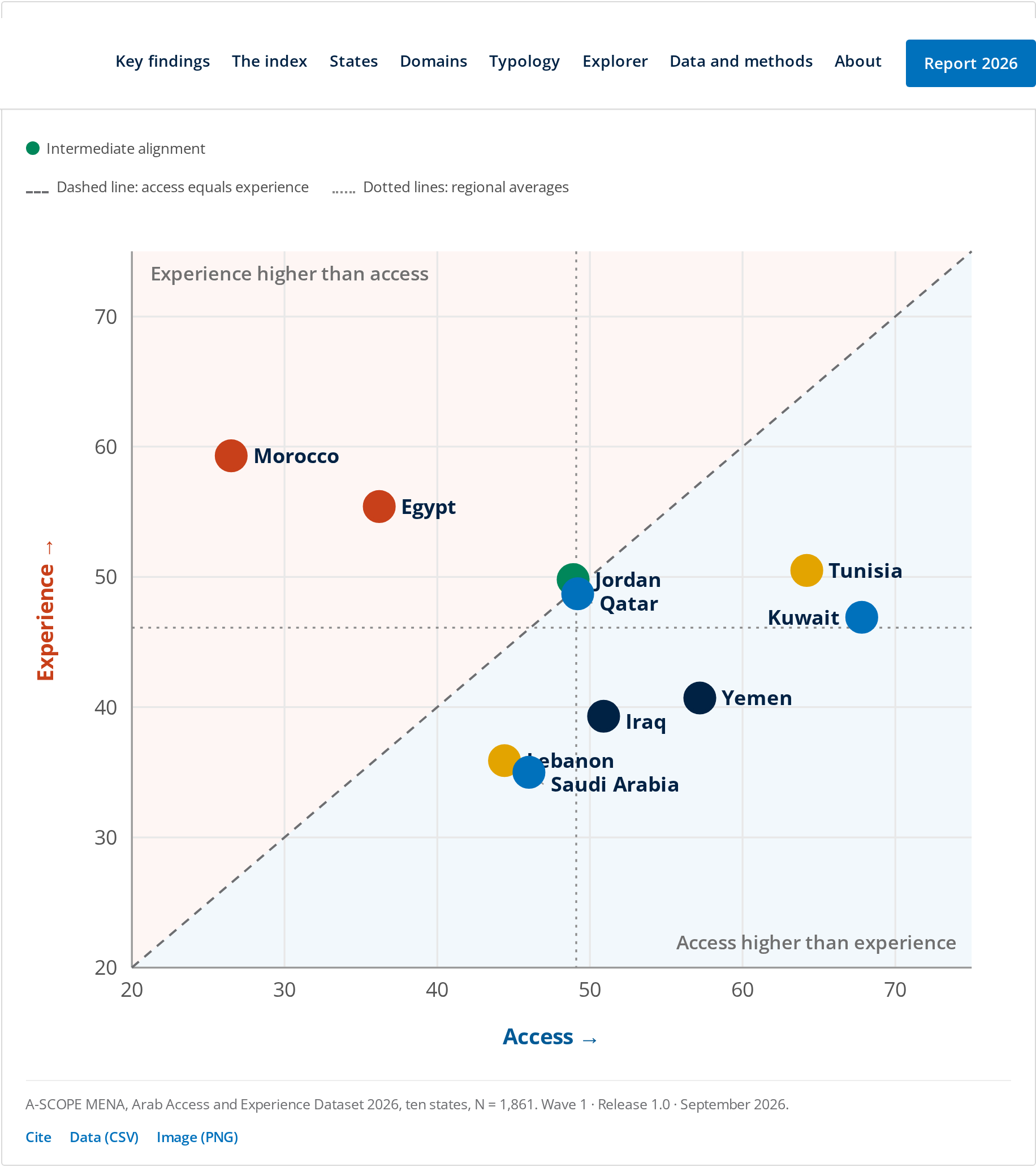
Capacity under scarcity: Iraq and Yemen
Delivery in conflict-affected states.
Iraq and Yemen record the lowest experience indices (40.4 and 42.2), the largest gaps and the lowest digital access and safety. Yemen nevertheless records the highest access on services (66.8) and among the highest on family contact, self-rated health and education.
The service score reflects receipt of assistance: 158 of 252 Yemeni respondents report it. The survey does not identify who provides the assistance. The pattern is consistent with, but does not establish, the possibility that humanitarian provision compensates for weak state capacity. What the data do show is that assistance received is not experienced as adequate: experience of services in Yemen is 36.8.
| Domain | Iraq: Access | Yemen: Access | Iraq: Experience | Yemen: Experience | regional mean: Access | regional mean: Experience |
|---|---|---|---|---|---|---|
| Digital access and use | 30.8 | 30.0 | 33.8 | 37.9 | 57.3 | |
| Safety and policing | 43.8 | 55.1 | 43.2 | 44.3 | 55.8 | |
| Health and care | 64.8 | 78.8 | 36.9 | 32.7 | 48.2 | |
| Family and social relationships | 71.2 | 85.5 | 36.9 | 37.1 | 55.6 | |
| Service provision and assistance | 50.7 | 66.8 | 36.7 | 36.8 | 46.4 |
A typology of administrative challenges
Five types derived from the shape of access and experience, with state notes.
The states are grouped by the shape of their access and experience profiles, not by regime or region. The typology follows the empirical problem: where in the chain from provision to experience the process appears to fail.
Provision–experience mismatchMaterial-access deficitAdministrative interface deficitCapacity under crisisIntermediate alignment
Dashed line: access equals experienceDotted lines: regional averages
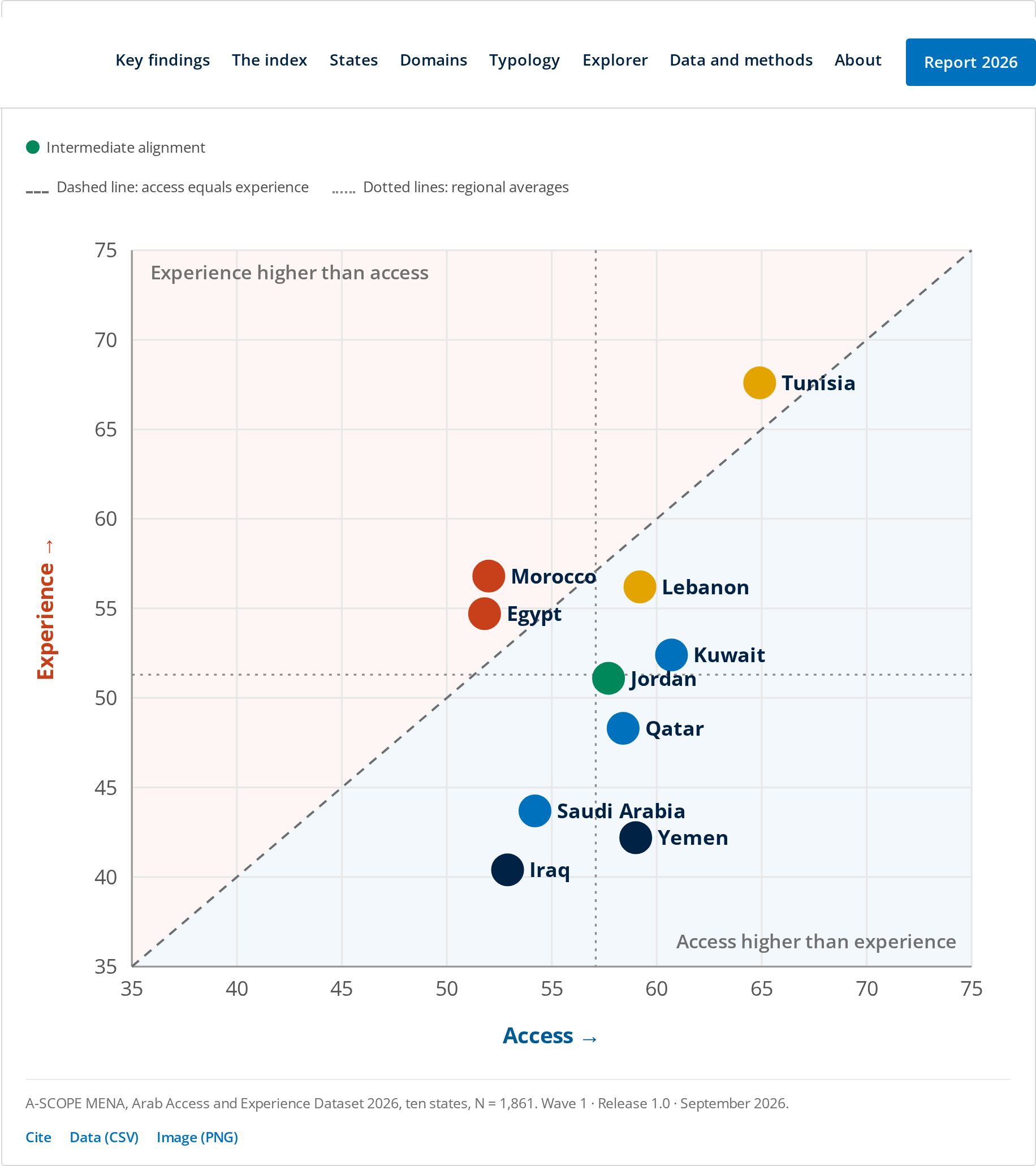
| Type | States | Administrative problem |
|---|---|---|
| Provision–experience mismatch | Qatar, Saudi Arabia, Kuwait | Turning provision into experience: quality, responsiveness and the experience of users. |
| Material-access deficit | Morocco, Egypt | Insufficient material provision that satisfaction data would understate. |
| Administrative interface deficit | Tunisia, Lebanon | Procedures, eligibility, information, complaint handling and channels of voice. |
| Capacity under crisis | Yemen, Iraq | Sustaining delivery and building durable state capacity amid instability. |
| Intermediate alignment | Jordan | Preserving alignment while addressing the weakest domains. |
State notes
Tunisia Index 66.2 · Access 64.9 · Experience 67.6 Administrative interface deficit
Index 66.2, above the regional mean, with the highest access (64.9) and the highest experience (67.6) in the sample and the widest spread between domains (56 points). Tunisia leads on nine of the eleven domains, with an access score of 100.0 on safety, and is last on education (32.0) and service provision (34.0): the domains of direct public provision are the weakest by a wide margin.
Lebanon Index 57.7 · Access 59.2 · Experience 56.2 Administrative interface deficit
Index 57.7, above the regional mean and close to parity (access 59.2, experience 56.2). Lebanon is second on digital access, housing and family relationships, last on civic participation (40.2) and second last on service provision (38.5). Material and social conditions are strong; the domains closest to the administrative interface are the weakest. Perceived safety is 22 points below reported safety.
Kuwait Index 56.6 · Access 60.7 · Experience 52.4 Provision–experience mismatch
Index 56.6, above the regional mean, with the second highest access in the sample (60.7) and experience of 52.4. Kuwait leads on service provision (57.9), is second on civic participation and environment, and has the most even profile (standard deviation 4.4). Access exceeds experience by 21 points on housing, 26 on family relationships and 16 on education.
Jordan Index 54.4 · Access 57.7 · Experience 51.1 Intermediate alignment
Index 54.4, near the regional mean, with access above the regional mean (57.7 against 57.1) and experience at it (51.1 against 51.3). No domain lies more than four points below the regional mean. The gap is widest on health (24.0) and safety (16.5).
Morocco Index 54.4 · Access 52.0 · Experience 56.8 Material-access deficit
Index 54.4, near the regional mean, second on experience (56.8) and ninth on access (52.0): the state where experience most exceeds access. Morocco is second on safety, finance and health and records the lowest access in the sample on civic participation (26.5) and services (25.8), and the second lowest on education (33.1), with experience well above access on each. The access measure identifies deficits that satisfaction would hide.
Qatar Index 53.4 · Access 58.4 · Experience 48.3 Provision–experience mismatch
Index 53.4, near the regional mean, access 58.4 and experience 48.3. The gap is 34.3 points on health and 28.5 on family relationships. Qatar is second on education and services and records low access on digital use (34.5).
Egypt Index 53.3 · Access 51.8 · Experience 54.7 Material-access deficit
Index 53.3, near the regional mean, with experience above access (54.7 and 51.8). Egypt records the lowest access index in the sample; experience exceeds recorded access by 19 points on civic participation and on services. Access, not satisfaction, is where the deficit lies.
Yemen Index 50.6 · Access 59.0 · Experience 42.2 Capacity under crisis
Index 50.6, below the regional mean, with the largest access–experience gap in the sample (access 59.0, experience 42.2). High recorded contact, self-rated health and receipt of assistance (66.8 on services) sit beside low experience of care (32.7), support (37.1) and assistance (36.8). Digital access and safety are low on both measures.
Saudi Arabia Index 49.0 · Access 54.2 · Experience 43.7 Provision–experience mismatch
Index 49.0, below the regional mean, access 54.2 and experience 43.7. The gap is 34.5 points on health and 31.8 on family relationships. Saudi Arabia is last on environment and leisure and records low access on safety (50.0) and digital use (38.8).
Iraq Index 46.7 · Access 52.9 · Experience 40.4 Capacity under crisis
Index 46.7, below the regional mean, access 52.9 and experience 40.4, the lowest experience in the sample. Iraq is last on digital access, safety, health and family relationships; civic participation and housing are closer to the regional mean.
Discussion: the public administration of access
Four propositions.
Provision is not implementation. A government can put infrastructure and entitlements in place without producing access that residents report. The access measure records the result of implementation, not the provision behind it.
Access is not utilisation. Formal availability does not guarantee use. Where the access items record availability and use separately, use falls well below availability: pooled across the ten samples, leisure facilities are reported present in 68 per cent of answers and used in 44 per cent; civic organisations are reported nearby in 59 per cent and membership in 31 per cent.
Utilisation is not experience. People may use a service and judge it inadequate, unaffordable, irrelevant or unresponsive. Health and care, where good health sits beside low satisfaction with care, and service provision in Yemen, where receipt of assistance sits beside low satisfaction with it, are the clearest cases.
Administrative capacity as a link between provision and experience. The proposition that administrative capacity determines how far provision becomes effective and experience is consistent with the evidence at the level of states and domains. It is not tested by it. Testing it requires data the survey does not contain: administrative records, procedures, expenditure and front-line practice, linked to respondents.
Administrative reform implications
Six implications that follow from the evidence without exceeding it.
(i) Improve service responsiveness. Simplified procedures, feedback and complaint mechanisms, and transparency of decisions address the stage of the chain the survey cannot observe and the domains where the gap is widest.
(ii) Measure experience. Coverage and infrastructure indicators miss the divergence documented in this report; experience measures belong in the performance frameworks of service agencies.
(iii) Target the gaps between access and experience. Where access is high and experience low (health and family relationships everywhere; the Gulf states and the conflict-affected states on the index), quality, affordability, relevance and responsiveness are the first places to look.
(iv) Address material deficits. Where experience exceeds access (Morocco and Egypt; civic participation, services and education in particular), satisfaction masks a deficit that expanded provision would address.
(v) Build administrative continuity. In Iraq and Yemen, sustaining delivery through the transition from humanitarian to state provision is the precondition for improving experience.
(vi) Measure access and experience in every survey. Statistical offices and service agencies can collect access and experience in the same instrument, with probability samples, disaggregation and repeated waves.
Conclusion
The administrative challenge is turning provision into experience.
The evidence from ten Arab states is that access and experience are distinct, that they diverge in patterns that differ by domain and by state, and that the domains closest to the administrative interface are among the weakest and move against the overall index. The central administrative challenge is not only to provide more, but to turn provision into access that residents can use and value. Measuring both, and reading the distance between them, is where public administration can begin.
Annex A. Methodology
Instrument
A-SCOPE MENA adapts the Social and Community Opportunities Profile (Huxley et al., 2012) to the Arab region. It covers eleven domains, eight from the source instrument and three added for the region: civic participation and voice, environmental conditions, and service provision and assistance. Each domain combines questions on access and on experience.
Sample
Fieldwork took place in 2023 and 2024 in ten Arab League states, all of which are reported: Jordan (n = 299), Morocco (254), Egypt (253), Yemen (252), Tunisia (251), Kuwait (129), Qatar (119), Lebanon (103), Iraq (101) and Saudi Arabia (100), N = 1,861. Samples are non-probability samples; scores describe respondents, not national populations.
Scoring
The raw country files were aligned to the questionnaire column by column by matching each column against the response set the questionnaire documents. 188 items are scored, 120 on the access measure and 68 on the experience measure. Each item is rescaled to 0 to 100 in the direction of access or positive experience, with the direction taken item by item from its response options. Do not know, not applicable and any value outside the documented set are missing; nothing is imputed. A respondent measure score is the mean of the items answered (at least two, or one for short batteries). A state domain score is the mean of its two measures; the index is the unweighted mean of the eleven domains; the access–experience gap is access minus experience.
In eight states some four-point items were administered on five-point scales and are rescaled on the scale used. Receipt of government or non-governmental assistance counts as access to services, following the source instrument.
Limitations
(i) Non-probability samples of 100 to 299 per state. (ii) Cross-sectional design. (iii) Item response between 52 per cent (Morocco) and 96 per cent (Tunisia); non-response is not random. (iv) Cultural differences in the expression of satisfaction affect the experience measure. (v) Iraq and Yemen were affected by conflict during fieldwork. (vi) In four files, respondents share identical answers on all 188 scored items with at least one other respondent while differing on unscored fields. The number of distinct answer patterns is 7 of 251 in Tunisia, 22 of 101 in Iraq, 41 of 100 in Saudi Arabia and 66 of 119 in Qatar. Removing the duplicated patterns changes the index by 0.2 points or less for Tunisia, Iraq and Saudi Arabia and lowers Qatar from 53.4 to 52.0; the position of Tunisia cannot be tested in this way. Scores are reported as the data give them. (vii) Twelve Arab League states are not covered. (viii) Some access scores (digital use and safety in Saudi Arabia and Qatar) are out of line with other evidence and are read at item level before policy use. (ix) The data do not measure administrative capacity or service delivery; all administrative explanations are inferences.
Representativeness and how to read the results
The samples are not representative. The A-SCOPE MENA samples were not drawn by probability methods from a defined sampling frame. The probability that any resident was selected is unknown, no design or post-stratification weights are applied, and the composition of each sample was not controlled to match the population by age, sex, region, urban or rural residence, education, employment or nationality. Samples range from 100 to 299 respondents per state. The scores therefore describe the people who were surveyed. They are not estimates for the national populations of the ten states, and they cannot be generalised to those populations.
Consequences for the reading of results. (i) Because selection probabilities are unknown, the usual measures of sampling error, standard errors, confidence intervals and significance tests, cannot be computed in a meaningful way, and none is reported. (ii) Differences between states may reflect differences in who was surveyed as much as differences in conditions or in public administration. A state whose sample includes more educated, urban or employed respondents will tend to score higher on several domains for that reason alone. (iii) Small differences carry no interpretive weight: Jordan and Morocco share a score of 54.4, and Qatar (53.4) and Egypt (53.3) differ by a tenth of a point. Rankings are indicative orderings of the samples, not league tables of states. (iv) Comparisons within a state, between domains and between the access and experience tracks, are less exposed to sample composition than comparisons between states, because both measures are answered by the same respondents; they remain affected by it.
How the results should be used. The index, the typology and the domain analyses are exploratory and descriptive. They identify patterns, above all the divergence between access and experience, that merit explanation and testing. They should be read as hypotheses about where conversion from provision to experience may be failing, not as measurements of national conditions or of government performance. They should not be used to set policy targets, to allocate resources, to evaluate or rank governments, or as a substitute for official statistics. Any citation of a score should carry this qualification.
The next wave. Future work of the observatory will focus on representative surveys. The next wave is designed around probability samples drawn from defined national frames, stratified by region and by urban and rural residence and, where relevant, by nationality; sample sizes sufficient to support estimates for the main population groups; survey weights, published design effects and confidence intervals for every score; standardised fieldwork protocols with quality controls, including checks for duplicated records; and extended coverage of Arab League states in repeated waves. Until such data are available, the present results are a first description of access and experience in ten samples, and a basis for the questions a representative survey should answer.
Citation
Ben Brik, A. (2026). From Provision to Experience: A Public Administration Analysis of Access to Services, Resources and Opportunities in the Arab States. Arab Access and Experience Index (AAEI) 2026. مرصد الإدارة, Administration Observatory in the Arab Region.
Data: A-SCOPE MENA: Arab Access and Experience Dataset, 2026. Ben Brik, A. and Taylor Brown, C.
Annex B. Data tables
| State | Leisure | Digital | Housing | Safety | Finance | Education | Health | Social | Civic | Environment | Services | Average |
|---|---|---|---|---|---|---|---|---|---|---|---|---|
| Tunisia | 34.5 | 58.8 | 92.6 | 100.0 | 89.9 | 25.3 | 76.8 | 81.3 | 64.2 | 63.6 | 26.5 | 64.9 |
| Lebanon | 36.7 | 62.5 | 75.2 | 78.8 | 53.9 | 63.5 | 71.6 | 74.3 | 44.4 | 61.8 | 28.8 | 59.2 |
| Kuwait | 46.7 | 59.0 | 66.4 | 59.3 | 62.5 | 57.8 | 63.9 | 76.3 | 67.8 | 51.7 | 56.1 | 60.7 |
| Jordan | 43.5 | 56.0 | 65.8 | 73.3 | 59.0 | 49.3 | 73.8 | 70.3 | 48.9 | 50.1 | 44.5 | 57.7 |
| Morocco | 34.6 | 44.1 | 58.9 | 71.4 | 68.1 | 33.1 | 77.8 | 73.3 | 26.5 | 58.4 | 25.8 | 52.0 |
| Qatar | 47.4 | 34.5 | 62.2 | 67.4 | 55.1 | 67.2 | 73.3 | 75.6 | 49.2 | 46.9 | 63.9 | 58.4 |
| Egypt | 38.1 | 52.3 | 57.3 | 67.3 | 47.9 | 44.6 | 68.6 | 71.4 | 36.2 | 51.1 | 35.7 | 51.9 |
| Yemen | 57.5 | 30.0 | 63.1 | 55.1 | 47.4 | 67.2 | 78.8 | 85.5 | 57.2 | 39.7 | 66.8 | 58.9 |
| Saudi Arabia | 47.8 | 38.8 | 67.7 | 50.0 | 55.5 | 52.6 | 74.3 | 71.5 | 46.0 | 35.6 | 56.5 | 54.2 |
| Iraq | 57.7 | 30.8 | 59.9 | 43.8 | 52.7 | 51.5 | 64.8 | 71.2 | 50.9 | 48.3 | 50.7 | 52.9 |
| Average | 44.5 | 46.7 | 66.9 | 66.6 | 59.2 | 51.2 | 72.4 | 75.1 | 49.1 | 50.7 | 45.5 | 57.1 |
| State | Leisure | Digital | Housing | Safety | Finance | Education | Health | Social | Civic | Environment | Services | Average |
|---|---|---|---|---|---|---|---|---|---|---|---|---|
| Tunisia | 81.3 | 94.3 | 66.4 | 76.4 | 63.9 | 38.7 | 78.4 | 87.0 | 50.5 | 65.2 | 41.5 | 67.6 |
| Lebanon | 61.4 | 70.5 | 64.8 | 57.1 | 51.7 | 59.9 | 48.1 | 69.7 | 35.9 | 51.2 | 48.2 | 56.2 |
| Kuwait | 47.7 | 62.7 | 45.0 | 52.6 | 56.7 | 42.0 | 48.8 | 50.7 | 46.9 | 63.9 | 59.7 | 52.4 |
| Jordan | 47.8 | 63.6 | 53.4 | 56.8 | 46.6 | 48.1 | 49.8 | 55.8 | 49.8 | 43.5 | 47.4 | 51.1 |
| Morocco | 56.8 | 55.6 | 58.0 | 70.3 | 52.8 | 47.5 | 57.4 | 69.2 | 59.3 | 45.0 | 52.6 | 56.8 |
| Qatar | 42.7 | 50.1 | 46.4 | 54.3 | 49.0 | 57.8 | 39.0 | 47.1 | 48.7 | 52.7 | 44.1 | 48.4 |
| Egypt | 53.6 | 61.9 | 54.4 | 58.9 | 49.1 | 50.6 | 50.9 | 63.2 | 55.4 | 48.7 | 55.0 | 54.7 |
| Yemen | 41.3 | 37.9 | 44.3 | 44.3 | 43.6 | 60.0 | 32.7 | 37.1 | 40.7 | 45.5 | 36.8 | 42.2 |
| Saudi Arabia | 41.5 | 42.2 | 51.2 | 44.0 | 48.9 | 52.2 | 39.8 | 39.7 | 35.0 | 44.6 | 41.7 | 43.7 |
| Iraq | 37.3 | 33.8 | 50.6 | 43.2 | 41.7 | 44.3 | 36.9 | 36.9 | 39.3 | 43.7 | 36.7 | 40.4 |
| Average | 51.1 | 57.3 | 53.5 | 55.8 | 50.4 | 50.1 | 48.2 | 55.6 | 46.1 | 50.4 | 46.4 | 51.4 |
| State | Leisure | Digital | Housing | Safety | Finance | Education | Health | Social | Civic | Environment | Services | Average |
|---|---|---|---|---|---|---|---|---|---|---|---|---|
| Tunisia | 57.9 | 76.6 | 79.5 | 88.2 | 76.9 | 32.0 | 77.6 | 84.1 | 57.4 | 64.4 | 34.0 | 66.2 |
| Lebanon | 49.1 | 66.5 | 70.0 | 68.0 | 52.8 | 61.7 | 59.8 | 72.0 | 40.2 | 56.5 | 38.5 | 57.7 |
| Kuwait | 47.2 | 60.8 | 55.7 | 56.0 | 59.6 | 49.9 | 56.3 | 63.5 | 57.3 | 57.8 | 57.9 | 56.5 |
| Jordan | 45.7 | 59.8 | 59.6 | 65.1 | 52.8 | 48.7 | 61.8 | 63.0 | 49.3 | 46.8 | 45.9 | 54.4 |
| Morocco | 45.7 | 49.8 | 58.4 | 70.9 | 60.5 | 40.3 | 67.6 | 71.3 | 42.9 | 51.7 | 39.2 | 54.4 |
| Qatar | 45.0 | 42.3 | 54.3 | 60.8 | 52.0 | 62.5 | 56.1 | 61.3 | 49.0 | 49.8 | 54.0 | 53.4 |
| Egypt | 45.8 | 57.1 | 55.9 | 63.1 | 48.5 | 47.6 | 59.7 | 67.3 | 45.8 | 49.9 | 45.3 | 53.3 |
| Yemen | 49.4 | 33.9 | 53.7 | 49.7 | 45.5 | 63.6 | 55.8 | 61.3 | 49.0 | 42.6 | 51.8 | 50.6 |
| Saudi Arabia | 44.7 | 40.5 | 59.5 | 47.0 | 52.2 | 52.4 | 57.1 | 55.6 | 40.5 | 40.1 | 49.1 | 49.0 |
| Iraq | 47.5 | 32.3 | 55.3 | 43.5 | 47.2 | 47.9 | 50.9 | 54.1 | 45.1 | 46.0 | 43.7 | 46.7 |
| Average | 47.8 | 52.0 | 60.2 | 61.2 | 54.8 | 50.7 | 60.3 | 65.3 | 47.6 | 50.6 | 45.9 | 54.2 |
§anC§Annex C. Survey questions by domain
Leisure and community participation
What the survey asks: access. Presence of community groups, clubs and organisations, of leisure and sports facilities; membership of groups; unpaid help given to others; frequency of leisure activities.
What the survey asks: experience. Views on the range of opportunities to take part, to volunteer and to use leisure time; satisfaction with leisure activities.
Digital access and use
What the survey asks: access. Internet use at home or elsewhere; household access to a computer and a mobile telephone; use of AI tools; use of the internet for essential information and social media; experience of hacking or blocking.
What the survey asks: experience. Satisfaction with internet access, views on opportunities to go online and on the range of opportunities available.
Housing
What the survey asks: access. Availability of suitable housing at an affordable price in the preferred area; a self-contained dwelling.
What the survey asks: experience. Feelings about the accommodation, the preference to stay in the area, views on opportunities to find suitable housing and on the range available.
Safety and policing
What the survey asks: access. Walking alone in the area after dark; victimisation by crime or assault in the past year.
What the survey asks: experience. Feeling safe after dark and in the area; satisfaction with public and personal safety; the expected likelihood of police protection, of abuse of power and of prosecution of officers.
Work, income and finance
What the survey asks: access. Employment status; arrears on rent or mortgage; ability to borrow a small sum; a bank near the home and its use for saving or credit.
What the survey asks: experience. Feelings about the current job or about not working, how well the household is managing, ease of covering housing costs, views on opportunities to find work and to increase income, and feelings about personal and household finances.
Education and training
What the survey asks: access. Qualifications held; enrolment in a course in the past year; adult learning and job-related training; expected future learning.
What the survey asks: experience. Views on the availability of educational opportunities, feelings about the range available and about their own education and training.
Health and care
What the survey asks: access. Self-rated health; limitation of work or daily activity by physical health.
What the survey asks: experience. Mood over the past four weeks; feelings about physical and mental health; views on opportunities to improve health and on the range available.
Family and social relationships
What the survey asks: access. Contact with parents, adult children, children and other relatives by visit, telephone and online; visits with friends and neighbours; going out.
What the survey asks: experience. Satisfaction with contact and relationships with family, with friendships and with opportunities to make friends and to meet people; feeling part of the community.
Civic participation and voice
What the survey asks: access. Civic events and organisations near the home and attendance or membership; perceived freedoms of expression, organisation, assembly, media and internet; opportunities to influence government decisions and having done so.
What the survey asks: experience. Views on opportunities to attend civic events, to join organisations and to influence government; feelings about these opportunities; expected accountability of officials and influence of criminal organisations.
Environmental conditions
What the survey asks: access. Having been affected by natural disasters or pollution in the past five years, six months and three months; preparedness for future disasters.
What the survey asks: experience. Views on the actions taken to recover from disasters and to deal with pollution, and feelings about the range of actions taken.
Service provision and assistance
What the survey asks: access. Eligibility for and receipt of government social assistance and assistance from non-governmental or charitable organisations; eligibility for and receipt of legal aid.
What the survey asks: experience. Views on the assistance and legal aid received and on the range of opportunities to obtain them; the expected likelihood of obtaining social assistance and legal aid without a bribe or informal payment.
References
- Ben Brik, A. and Brown, C. T. (2025). Critical review of conceptualisation and measurement of social inclusion: directions for conceptual clarity. Social Policy and Society, 1–18. https://doi.org/10.1017/S1474746425000302
- Brik, A. B. and Brown, C. T. (2024). Global trends in social inclusion and social inclusion policy: a systematic review and research agenda. Social Policy and Society, 1–24. https://doi.org/10.1017/S147474642400054X
- Brown, C. T. and Brik, A. B. (2024). Welfare regime typologies: the six worlds of social inclusion. International Journal of Community and Social Development. https://doi.org/10.1017/ics.2024.14
- Ben Brik, A. and Taylor Brown, C. (2025). A-SCOPE MENA: adapting the Social and Community Opportunities Profile for the Arab world. Methodological paper, available on request.
- Huxley, P. et al. (2012). Development of a social inclusion index to capture subjective and objective life domains (Phase II): psychometric development study. Health Technology Assessment, 16(1), 1–248. https://doi.org/10.3310/hta16010
Administration Observatory in the Arab Region
Citizens Voice
mena-inclusion.org · anis.ben.brik@usi.ch